
Kartavirya Arjuna mantra: the ancient chant to recover what is lost
If you have lost something dear to you, a phone, a document, a piece of jewellery, or even a pet, you may have come across the Kartavirya Arjuna mantra. It is one of the oldest and most trusted Sanskrit chants for recovering things that are lost or stolen. This is not a modern internet trend. It comes from a real stotram found in Hindu scripture, built around a king who is remembered as one of the strongest rulers in all of Puranic history.
In this post, we will go through the exact lyrics, the true origin of the mantra, what each line actually means at a deeper level, and how Vedic astrology connects the thousand armed king to the planet Mars. By the end, you will understand why this simple chant has survived for thousands of years and how to use it correctly.
What is the Kartavirya Arjuna mantra
The Kartavirya Arjuna mantra is a short Sanskrit verse taken from a longer hymn called the Karthaveeryarjuna Dwadasa Nama Stotram, meaning the twelve name hymn to Kartavirya Arjuna. The most chanted line, the one most people search for, goes like this.
Om Karthaveeryarjuno nama Raja baahu sahastravan Tasya smarana mathrena Gatham nashtam cha labhyathe
In plain English, this means, salutations to Kartavirya Arjuna, the king with a thousand arms. By merely remembering him, that which is lost is found again.
People across South India in particular chant this line the moment they misplace something. Elders often teach it to children as one of the first practical mantras they learn, right alongside prayers for safety and health.
Who was Kartavirya Arjuna
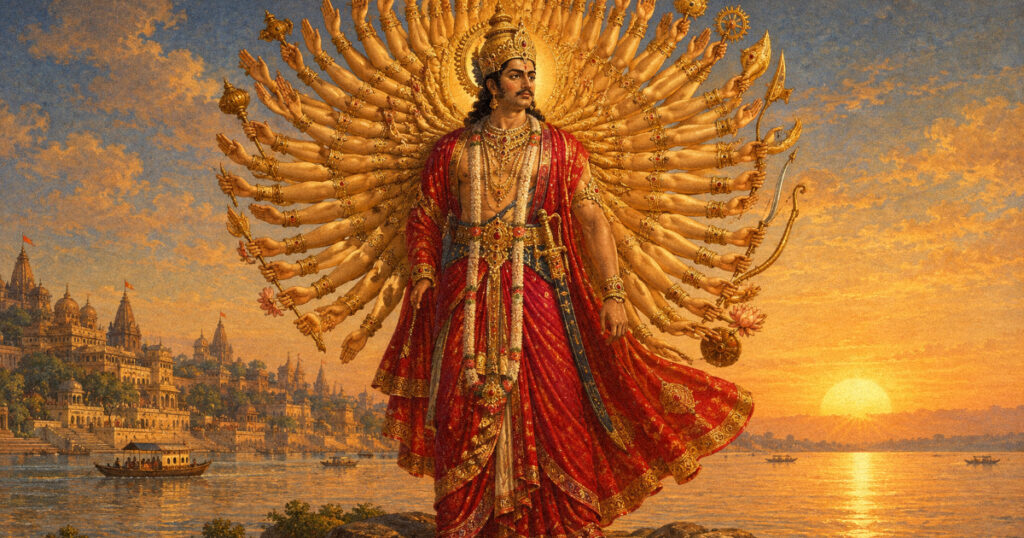
To understand the Karthaveeryarjuna stotram properly, you need to know who this king actually was. Kartavirya Arjuna was the ruler of the Haihaya dynasty, son of King Kritavirya. According to the Puranas, he is described as a partial manifestation, an amsha, of the Sudarshana Chakra, the divine discus of Lord Vishnu.
He earned his thousand arms through deep and sincere tapasya to the sage Dattatreya. With that boon, his rule became so complete and commanding that old texts say even the ocean drew back in his presence. He is also remembered for defeating Ravana in battle and holding him captive for a period, long before Ravana’s more famous conflict with Lord Rama.
His story does end in defeat, at the hands of Parashurama, after a dispute involving the sage Jamadagni’s wish granting cow. But that ending does not take away from what he represents in this mantra. He stands for total, unmatched command over the material and physical world.
The deeper meaning behind the lyrics
Most translations of this mantra stop at the surface, a king remembered, a lost item found. But if you sit with the Sanskrit a little longer, there is a lot more happening.
The word sahastravan does not simply mean many hands. It points to a kind of power that reaches every direction at once, nothing is out of range, nothing escapes attention. This is important because it sets up the real teaching of the mantra.
The phrase smarana mathrena is the heart of the whole verse. It does not mean idle thinking. Smarana in Sanskrit refers to focused, deliberate remembrance, the kind of mental act used in deep meditation. The mantra is telling you that the return of the lost object depends on this one act, steady remembrance, and nothing else. No ritual, no offering, no elaborate ceremony is asked for.
This is why the mantra to find lost things works differently from what people expect. It was never designed as a magic spell that fetches your item back on its own. It was designed to change the state of your mind first.
Why remembrance helps you find what is lost
Think about the last time you lost something important. Your first reaction was probably panic, followed by a scattered, frantic search. You checked the same drawer three times and somehow still missed what was right there.
This is the real problem the old sages were addressing. A panicked mind cannot recall clearly and cannot search properly. The Kartavirya Arjuna mantra works by giving your mind one steady, powerful image to hold onto, a king whose thousand arms cover every direction with total calm and total command. When you chant the line and hold that image, your own scattered attention gathers back together.
Once your mind is calm and focused again, your memory of where you actually kept the item becomes clear. Most lost things are found not on the first frantic search but on the second, calmer one. This mantra exists to get you to that second search faster.
Vedic astrology and the connection to Mars
The Kartavirya Arjuna mantra has a strong connection to Vedic astrology, specifically to the planet Mars, known as Kuja or Mangal.
Mars in a birth chart governs courage, physical strength, action, land, property and the drive to protect what belongs to you. A well placed Mars gives a person the ability to hold onto their possessions and fight for their rights when needed. A weak or afflicted Mars often shows up in real life as sudden loss, theft, accidents, disputes over property, or things slipping out of a person’s hands again and again.
Kartavirya Arjuna, with his thousand arms reaching in every direction, is the mythic picture of Mars functioning at its absolute highest and most dharmic level. Not aggression for its own sake, but disciplined strength used to protect, to rule fairly, and to hold onto what is rightfully yours. This is why a Vedic astrology Mars mantra built around this king carries so much weight. It is not borrowing power from a random deity. It is invoking the exact planetary energy responsible for possession, protection and recovery.
If you often lose things, misplace valuables, or deal with repeated theft in your life, a Vedic astrologer would likely point you toward your Mars placement first. Chanting this mantra alongside strengthening Mars through other remedies tends to give more lasting results than chanting alone.
Karma and the honest limits of this mantra
Vedic tradition never pretends that every loss is accidental. Sometimes losing something is simply the closing of a small karmic account, a debt working itself out quietly. The Karthaveeryarjuna stotram does not deny this or try to override it.
What it offers instead is help within the boundary of your karma. Sincere remembrance of a being who represents total command over the material world can soften and speed up the return of something, if that something is actually meant to come back to you. If it was never meant to return, no amount of chanting will force it.
This honesty is actually one of the most valuable parts of the teaching. It keeps you grounded instead of promising a guarantee no mantra can truly give.
How to chant the mantra correctly
Using this mantra well is simple, but doing it with the right approach matters. Here is a grounded, practical method.
- The moment you realise something is missing, pause before you start searching frantically. Give yourself thirty seconds to sit still.
- Chant the four line verse quietly, either once, three times, or nine times. Odd numbers are traditionally preferred in Vedic practice.
- While chanting, picture the thousand arms as complete coverage, a reminder that nothing is truly out of reach.
- Let your breathing settle before you begin looking again.
- Search a second time with a calm and clear mind, often in the exact spot you already checked.
Many people report finding their item during this second, calmer search rather than the first one. This is not coincidence. It is the mantra doing exactly what it was designed to do, settling the mind before the mind goes looking.
The Kartavirya Arjuna mantra is a small piece of scripture carrying a very old and very practical teaching. It tells you that a scattered mind loses things, and a focused mind finds them again. Behind the story of a thousand armed king lies a real lesson about attention, memory and the planetary energy of Mars that governs what we hold onto in life.
The next time you misplace something, do not just search harder. Pause, chant the four lines, and let your mind settle first. That simple shift, taught by sages thousands of years ago, still works today.