Gajakesari yoga in Vedic astrology explained: Meaning, myths, and chart placement
What Gajakesari yoga in Vedic astrology really means
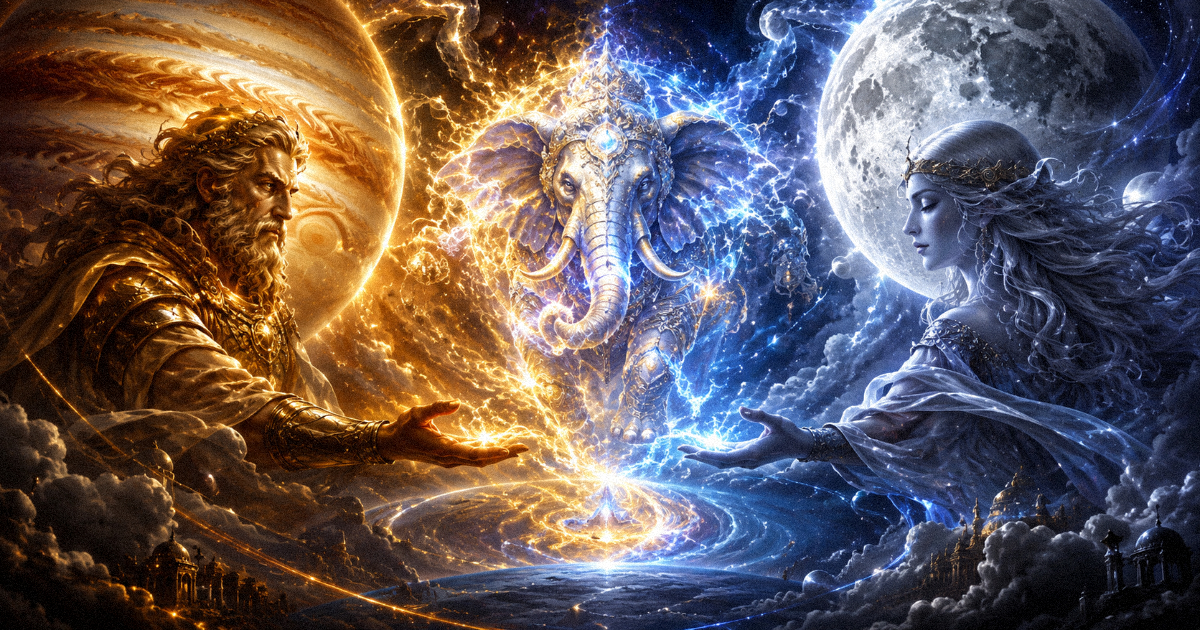
The term Gajakesari comes from two Sanskrit words: Gaja, meaning elephant, and Kesari, meaning lion. In ancient Indian texts, this planetary combination is described as an alignment that grants a person the massive strength, wisdom, and endurance of an elephant, paired with the fierce courage, leadership, and commanding presence of a lion.
In a standard Vedic astrology chart, this specific yoga is formed when Jupiter and the Moon are in a mutual planetary relationship. Specifically, Jupiter must occupy a quadrant position (known as a Kendra) from the Moon. This means Jupiter is located in the 1st, 4th, 7th, or 10th house counting directly from the house where the Moon is placed.
Because Jupiter represents wisdom, expansion, spirituality, and wealth, and the Moon governs emotions, mindset, and public perception, their positive alignment creates a powerful resonance. When these two celestial bodies connect through a quadrant placement, they form a psychological and material foundation that helps an individual build a lasting reputation, accumulate resources, and outlast their competitors.
Common myths and what this alignment does not mean
There is a massive amount of misinformation online claiming that anyone born with a Gajakesari yoga alignment will automatically become a billionaire, a famous celebrity, or a flawless leader. This is simply inaccurate. Astrology does not operate on isolated combinations.
Here is what the presence of this yoga does not guarantee:
- Instant wealth without effort: The elephant and the lion are both symbols of hard work and majestic duty. An elephant carries heavy loads, and a lion must hunt for its pride. This combination provides the capacity for high-level management, not a lottery ticket.
- Immunity from planetary affliction: If Jupiter or the Moon is heavily compromised in the birth chart, the expression of the yoga changes drastically.
- A completely stress-free life: Many historical figures with this exact placement faced massive public betrayals, intense political battles, and deep personal losses. The yoga gave them the resilience to survive the chaos, not a pass to avoid it.
When you look at a Vedic astrology chart, you cannot simply look at Jupiter and the Moon in isolation and proclaim that a person will live like a king. The strength of the houses involved dictates the actual arena where this energy shows up.
How Gajakesari yoga manifests in a real chart
To understand how this alignment actually operates in day-to-day life, you have to look at the specific houses Jupiter and the Moon occupy. The house placement tells you exactly where the “elephant and lion” energy will show up in a person’s life.
The 1st and 7th house axis
When the Moon is in the 1st house (the self) and Jupiter is in the 7th house (partnerships), or vice versa, the energy is highly public. These individuals often build their wealth through public-facing businesses, counseling, legal professions, or strategic alliances. They possess a natural charm that makes people trust their advice.
The 4th and 10th house axis
If the alignment happens between the 4th house of home, land, and emotions, and the 10th house of career and public status, the person usually finds success in real estate, governance, education, or large corporate structures. They are seen as stable pillars in their professional fields, acting as the protective “elephant” for their team or community.
Crucial factors that block or alter the results
An insightful reading requires checking the raw condition of both planets. A Gajakesari yoga can be weakened, altered, or even canceled out entirely by specific chart factors.
First, consider planetary ownership. If the Moon or Jupiter rules difficult houses (like the 6th, 8th, or 12th houses of debts, obstacles, and losses) for a specific ascendant, the material gains of the yoga may be heavily delayed or eaten up by unexpected expenses.
Second, look at planetary enemies. If Rahu, Ketu, or Saturn heavily aspect or conjunct either Jupiter or the Moon, it creates a serious blemish. For example, if Rahu is close to the Moon while Jupiter is in a quadrant, the individual might suffer from severe anxiety, overconfidence, or illusions of grandeur, which corrupts the clear wisdom that Jupiter is trying to provide.
Finally, the planetary degrees matter immensely. If Jupiter is at 29 degrees (infant state) or 0 degrees (dead state), its ability to expand the Moon’s potential is structurally limited. In these cases, the person feels the desire for greatness but struggles to ground it into physical reality.
The physical manifestation of this planetary combination primarily activates during the major planetary periods (known as Mahadashas) or sub-periods (Antardashas) of either Jupiter or the Moon. For individuals seeking exact chart readings, standard Vedic software packages (like Jagannatha Hora or Astro-Vision) require your exact birth time down to the minute, your birth date, and your exact geographic latitude and longitude coordinates to calculate these house boundaries accurately.
If you want to understand how to make the best use of this placement, if it is present in your chart, consider booking a consultation with us.



2 Comments