
Sunapha Yoga in Vedic Astrology: What it really means and what people get wrong
Sunapha Yoga in Vedic Astrology
If you have spent any time looking into Vedic astrology, you have probably come across the term Sunapha Yoga at some point. Maybe someone told you that you have it in your chart. Maybe you saw a video online claiming that Sunapha Yoga makes you destined for extraordinary wealth and a royal lifestyle. Maybe you were even offered a paid consultation, a special gemstone, or a costly ritual to “activate” it.
This article is here to give you the real picture. No hype, no fear-mongering, and no attempt to sell you anything. Just an honest look at what Sunapha Yoga in Vedic astrology actually is, what the classical texts say about it, how it truly manifests in a person’s life, and what the internet has been getting wrong.
What Is Sunapha Yoga?
Let us start with the basics. In Vedic astrology, a “yoga” is a specific planetary combination in a birth chart that is believed to shape certain traits or life outcomes. The word “yoga” here does not mean physical exercise. It simply means a union or a configuration.
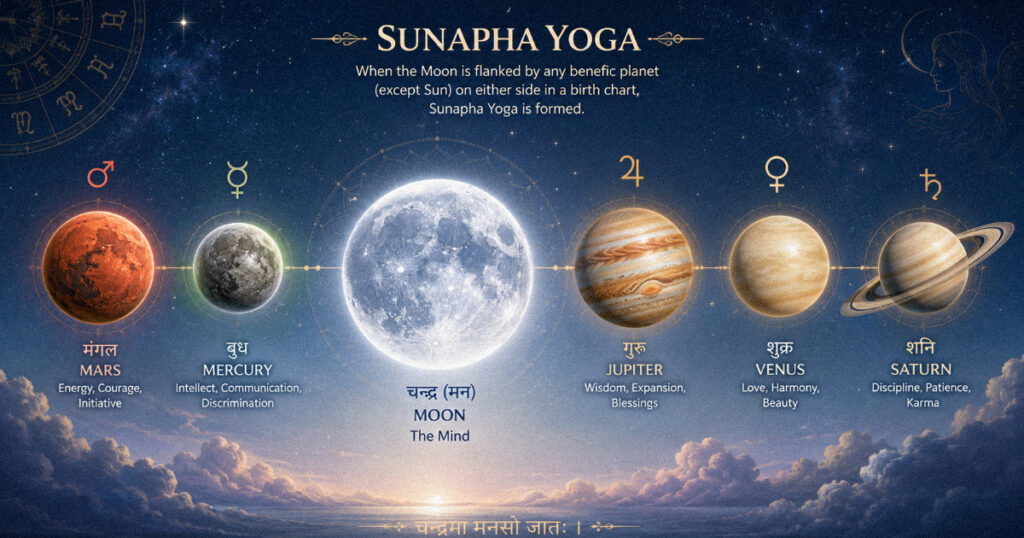
Sunapha Yoga is one of the most well-known Moon-based yogas in Jyotish. It forms when any planet, other than the Sun, Rahu, or Ketu, occupies the second house from the Moon in a person’s birth chart. That means if Mars, Mercury, Jupiter, Venus, or Saturn sits in the sign that comes immediately after the sign where your Moon is placed, you have Sunapha Yoga.
The name comes from Sanskrit. “Sunapha” roughly translates to “prosperous” or “next to the Moon,” and the yoga is fundamentally about giving support and strength to the Moon from the front, so to speak.
To understand why this matters, you need to understand the role of the Moon in Vedic astrology. The Moon represents the mind, emotions, inner stability, and the capacity for intuition. When the Moon has planetary support nearby, especially from the second house, the mind gains direction, resource, and the ability to accumulate. When the Moon is completely isolated, with no planets on either side, the result is what is called Kemadruma Yoga, which is associated with mental restlessness and scattered energy.
Sunapha Yoga is essentially the opposite of that isolation.
The Classical Sources: What did the ancient astrologers really say about this Sunapha Yoga?
The two foundational texts most often cited for Sunapha Yoga are the Brihat Parashara Hora Shastra and Varahamihira’s Brihat Jataka.
Varahamihira, one of the most respected astrologers from classical India, described the person with Sunapha Yoga as someone who would become wealthy through their own labour, attain fame, and rise to a position of influence comparable to a king. The Phaladeepika and Parashara Hora similarly describe a native who earns property, builds a good reputation, and gains respect for their intellectual abilities.
Now here is the key point that most modern content completely overlooks: these texts were written in a time when kings literally existed, when occupations were far more fixed, and when the language of astrology was poetic and symbolic rather than literal. When the ancients said “equivalent to a king,” they were pointing to qualities like self-sufficiency, leadership, earned respect, and authority. They were not writing cheques for guaranteed riches.
The classical definition also makes clear that the effects of Sunapha Yoga depend entirely on which planet is involved.

How the Sunapha Yoga actually works (planet by planet)
This is the part that most websites gloss over with a generic list. The reality is that the planet sitting in the second house from your Moon dramatically changes what Sunapha Yoga looks like in your life.
Mars in the second house from the Moon gives courage, determination, and a tendency toward leadership or physical enterprise. The person may accumulate wealth through effort, competition, or fields that require boldness, like sports, construction, the military, or entrepreneurship. However, this combination can also make someone sharp-tongued or aggressive.
Mercury in the second house from the Moon is perhaps the most celebrated form of this yoga when it comes to intellect. Mercury rules communication, trade, and analytical thinking. This version of Sunapha Yoga tends to show up as strong verbal or written expression, skill in business or finance, and a love for learning. Think of the person who builds wealth through their words, their ideas, or their ability to negotiate and trade.
Jupiter in the second house from the Moon brings wisdom, generosity, and a certain kind of dignified prosperity. This combination often appears in the charts of teachers, advisors, legal minds, and people who rise through reputation and moral standing rather than aggressive hustle. It is perhaps the most classically “royal” version of the yoga.
Venus in the second house from the Moon gives charm, aesthetic sensibility, and an affinity for luxury, beauty, and creative fields. Wealth can come through arts, fashion, entertainment, or any field where grace and appeal matter. This is the yoga of the artist who becomes financially comfortable through their craft.
Saturn in the second house from the Moon is the most misunderstood version. Saturn here does not give a glamorous, fast-rising wealth story. Instead, it gives discipline, patience, and a slow but steady accumulation of resources. The person earns through persistence, hard work, and often through unconventional or service-oriented paths. Saturn’s Sunapha Yoga can look unremarkable on the surface until the years add up and you realise how much this person has quietly built.
Sunapha Yoga and the bigger picture: What else matters?
Here is a truth that separates grounded Vedic astrology from the kind you see on YouTube shorts that get millions of views: no yoga works in isolation.
A Sunapha Yoga formed by a strong, well-placed Jupiter in a chart where the Moon is exalted and the ascendant is powerful is going to look very different from a Sunapha Yoga formed by a retrograde Saturn conjunct Rahu in a debilitated sign in a chart where the Moon itself is weak and afflicted.
Several factors can strengthen or weaken Sunapha Yoga:
The strength of the Moon itself. If the Moon is debilitated, combust, or hemmed in by malefic planets, the yoga’s results will be muted even if it technically exists. The Moon is the anchor of this yoga. If the anchor is weak, the yoga drifts.
The condition of the planet forming the yoga. A planet that is exalted, in its own sign, or well-aspected gives much stronger results than one that is retrograde, combust, or placed in an enemy sign. A combusted planet, meaning one that is too close to the Sun and loses its independent strength, gives very diluted effects regardless of the yoga it is supposed to form.
The Dasha period. In Vedic astrology, results are time-specific. Even if you have a strong Sunapha Yoga in your chart, its most notable effects tend to manifest during the Mahadasha or Antardasha of the planet involved. This is why some people feel the yoga’s impact clearly in certain years of their life and not at other times.
Aspects and conjunctions. If the planet forming Sunapha Yoga is under heavy influence from a natural malefic through conjunction or aspect, the results can shift significantly, introducing struggle, delay, or a different flavour to the outcomes.
The relationship between Sunapha Yoga and its sibling yogas is also worth knowing. Anapha Yoga forms when a planet occupies the twelfth house from the Moon, and is associated with spending, enjoyment, and letting go. When both Sunapha and Anapha Yoga exist simultaneously, it creates Durudhara Yoga, which is generally considered one of the more powerful chart combinations because the Moon receives support from both directions.
Common myths about the Sunapha Yoga
The internet has turned Sunapha Yoga into a marketing tool. Here are the most common myths being peddled, and why they are misleading.
Myth 1: “Sunapha Yoga means you will be rich and live like royalty.”
This is the single biggest distortion. The yoga creates potential and a certain disposition toward self-earned success. It does not hand anyone a trust fund. The classical texts themselves say the wealth comes through one’s own labour. That means the yoga points to your capacity and your path. Whether you walk that path and how far you go depends on your effort, your environment, your choices, and the broader dynamics of your chart.
Think of it this way. A good soil quality does not guarantee a harvest. You still need to plant the right seeds, water them, and keep away the weeds.
Myth 2: “Sunapha Yoga is rare and special.”
It is not rare. Given that there are five planets that can form this yoga and that the Moon moves through different signs for each person, Sunapha Yoga is actually fairly common across the population. Millions of people have some version of it in their charts. The rarity and potency come from the quality of the yoga, not just its presence.
Myth 3: “All forms of Sunapha Yoga give the same results.”
As explained above, a Mars-based Sunapha Yoga and a Jupiter-based Sunapha Yoga can manifest in entirely different ways. Treating all 31 possible combinations of this yoga as identical is like saying all employees of a company have the same role just because they share the same employer.
Myth 4: “You need a paid ritual or gemstone to activate this yoga.”
This is where things cross from astrology into exploitation. Sunapha Yoga is a natal configuration. It is already in your chart. No ritual “activates” or “deactivates” a yoga. Remedies in Vedic astrology are a legitimate part of the tradition, but they are meant to support a weak planet, not to suddenly switch on a yoga that was sitting dormant. Be very cautious of anyone who tells you that your Sunapha Yoga is “blocked” and that they have a solution available for a fee.
Myth 5: “If your Moon is weak, this yoga cannot help you at all.”
A weak Moon does reduce the impact of Sunapha Yoga, but it does not erase it entirely. The planet in the second house from the Moon still exerts an influence. Astrology is not binary. Effects exist on a spectrum, and the whole chart must be read together.
How Sunapha Yoga realistically manifests in modern life
In practical, modern terms, someone with a strong Sunapha Yoga will often show one or more of these qualities:
They are typically self-reliant. Unlike someone who depends heavily on inherited wealth, family connections, or luck, the Sunapha native tends to build their own foundation. They earn their position through consistent effort.
They are mentally resourceful. The Moon rules the mind, and with a strong planet in the second house from it, the native often has an ability to think clearly about money, resources, and speech. They tend to be good at managing what they have.
They carry themselves with a certain dignity. There is often a quality of self-respect and quiet authority, not arrogance, but a settled sense of self that others notice.
They accumulate over time. This is not always a dramatic, overnight success story. More often, it is a steady build. The person makes good decisions, invests well, speaks wisely, and earns trust in their field.
Sunapha Yoga in Vedic astrology is a genuinely meaningful combination. The classical tradition has always held it in high regard for good reason. It points to a mind that is supported, a life that trends toward self-earned prosperity, and a person who often earns the respect of their peers through their own efforts.
But it is not a shortcut. It is not a guarantee. And it is certainly not something that needs to be “unlocked” through expensive services.
If you have Sunapha Yoga in your chart, the most important thing you can do is understand which planet is forming it, how strong both that planet and your Moon are, and what period of your life corresponds to the Dasha of that planet. That is where a skilled, ethical Vedic astrologer earns their value: not in telling you that you are destined for greatness, but in helping you understand the specific qualities and timing your chart points to, so you can make better decisions with the life you are actually living.
Astrology, at its best, is a map. Sunapha Yoga is one landmark on that map. Where you go from there is still up to you.