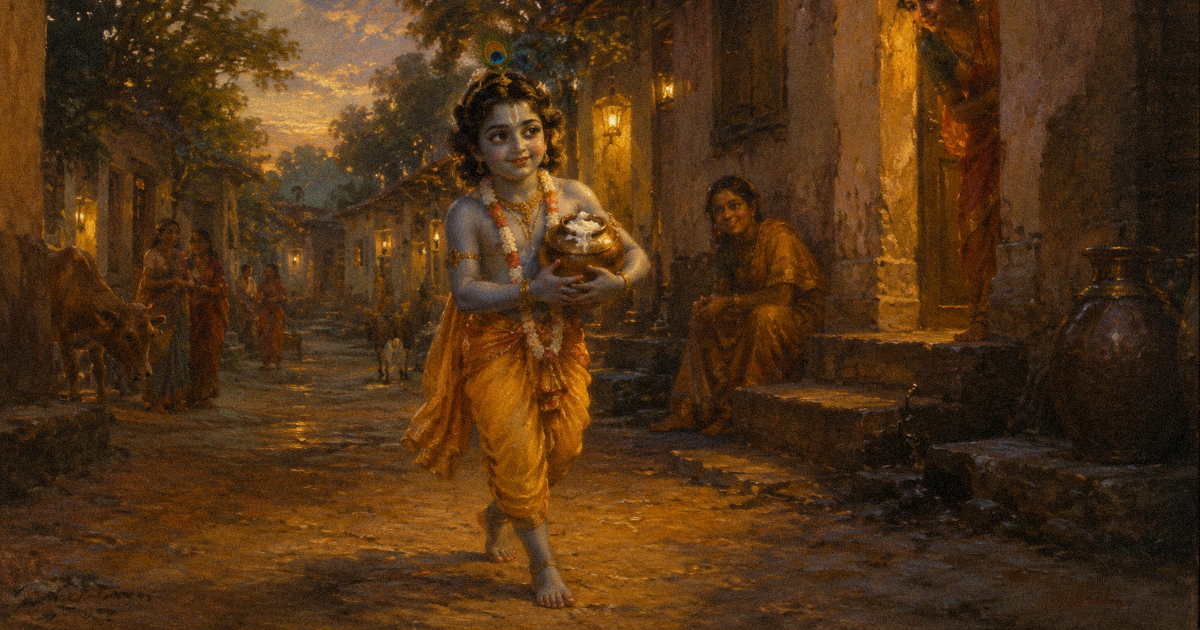
Madhurashtakam meaning explained: line by line analysis of all eight verses
Madhurashtakam meaning: a line by line look at all eight verses
If you have ever heard the Madhurashtakam sung, you will remember one thing before anything else. The word madhuram. It repeats again and again, almost at the end of every line, like a heartbeat that will not stop. This is not an accident. The Madhurashtakam meaning is built entirely around this one repeated idea, that everything connected to Krishna is sweet. Not sweet like sugar. Sweet like the feeling you get when someone you love walks into the room.
This hymn was written by Vallabhacharya, the founder of the Pushtimarg tradition of Krishna devotion, sometime around the late fifteenth or early sixteenth century. He wrote it as a short outburst of eight verses, and inside each verse, almost every single line names a different part of Krishna’s life and calls it sweet. To really understand the Madhurashtakam meaning, you have to slow down and look at each line on its own, because each one is doing its own small job inside the larger picture.
That is what we will do in this article. Line by line, verse by verse, we will go through the full text, and we will also look at why this idea of sweetness sits so naturally inside the wider world of Vedic thought, including the astrological idea of madhurya, or sweetness, connected to certain planets and certain kinds of love.
Verse one: adharam madhuram vadanam madhuram
Sanskrit line one: Adharam madhuram vadanam madhuram nayanam madhuram hasitam madhuram.
This opening line has four separate words, each one naming a part of Krishna’s face, and each one gets its own madhuram. Adharam means lips. Vadanam means face. Nayanam means eyes. Hasitam means smile. Notice how the line moves, from the lips, to the whole face, to the eyes, and then to the smile, which is really an action that pulls all three of those features together. This is not a random list. It moves from a single feature, to the whole, and then to an expression that brings the whole face alive.
The deeper Madhurashtakam meaning here is that Vallabhacharya begins with the most physical, most human details possible. He does not open with Krishna’s cosmic form or his role as an avatar of Vishnu. He opens with a face. This tells the listener right away that this hymn is not about theology.
It is about looking at someone you love and noticing every small detail of them, the way a mother looks at her child’s face for the first time, or the way someone in love studies the face of the person across the table.
Sanskrit line two: Hridayam madhuram gamanam madhuram madhuradhipate akhilam madhuram.
The second line moves inward and then outward. Hridayam means heart. Gamanam means walk or gait. First we go inside, to the heart, the seat of feeling and intention. Then we go outside again, to the walk, the way Krishna moves through the world. This pairing is important. In many traditions, a person’s inner nature and their outer movement are seen as connected. A restless heart shows in a restless walk.
A calm and loving heart shows in an easy, unhurried walk. By placing heart and walk side by side, this line suggests that Krishna’s inner sweetness is visible even in something as simple as the way he steps forward.
Then comes the refrain that closes every verse, madhuradhipate akhilam madhuram, oh Lord of sweetness, everything is sweet. Madhura means sweet, adhipate means lord or master. So Krishna is literally addressed here as the Lord of sweetness itself, not just someone who happens to be sweet, but the very source and ruler of that quality.
Akhilam means everything, entire, whole. This closing line acts like a summary and a seal at the end of the verse, gathering the four or five specific things just mentioned and widening them out to include absolutely everything.
Verse two: vachanam madhuram charitam madhuram
Sanskrit line one: Vachanam madhuram charitam madhuram vasanam madhuram valitam madhuram.
This verse shifts from the physical body to behavior and presentation. Vachanam means speech or words. Charitam means conduct, character, or the story of one’s actions. Vasanam means clothing or garments. Valitam means the turning or bending of the body, often used to describe a graceful curve or twist in movement, as seen in classical dance postures associated with Krishna.
Look at the pairing again. Speech and conduct go together, since what someone says and what someone does are the two pillars of character. Then clothing and body movement go together, since both are about outward presentation and grace. The Madhurashtakam meaning in this line is that sweetness is not only found in fixed physical features like a face, but also in dynamic, changing things, like the words someone chooses to speak, and how their body carries itself as they move.
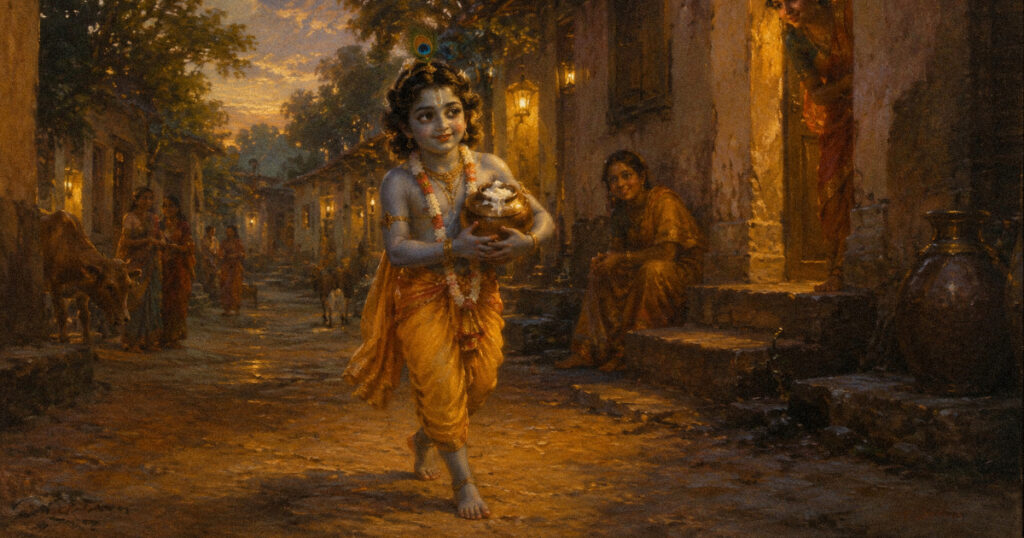
Even Krishna’s playful, mischievous stories, his charitam, are called sweet here, which is a bold claim, since many of his childhood stories involve stealing butter and teasing others.
Sanskrit line two: Chalitam madhuram bhramitam madhuram madhuradhipate akhilam madhuram.
Chalitam means walking or moving forward. Bhramitam means wandering, roaming, or moving around in circles, sometimes with a sense of playful confusion, as in Krishna wandering through the forests and lanes of Vrindavan without any fixed destination. This line completes the picture of verse two by returning to movement, but this time it is not the calm gait of verse one, gamanam, it is a more playful, unpredictable kind of movement, chalitam and bhramitam.
Even Krishna’s aimless wandering through the village lanes, which might look like having no purpose at all, is called sweet. Then the refrain closes the verse once again, tying speech, conduct, clothing, grace, walking, and wandering all together under the single idea of total sweetness.
Verse three: venur madhuro renur madhurah
Sanskrit line one: Venur madhuro renur madhurah panir madhurah padau madhurau.
This line has an unusual grammatical shape compared to the earlier verses, since here the word madhura changes its ending slightly to match the gender and number of each noun. This is a small but telling detail. Vallabhacharya is not just repeating the same word mechanically, he is fitting the idea of sweetness precisely onto each different object, the way you would tailor a compliment to fit exactly what you are praising.
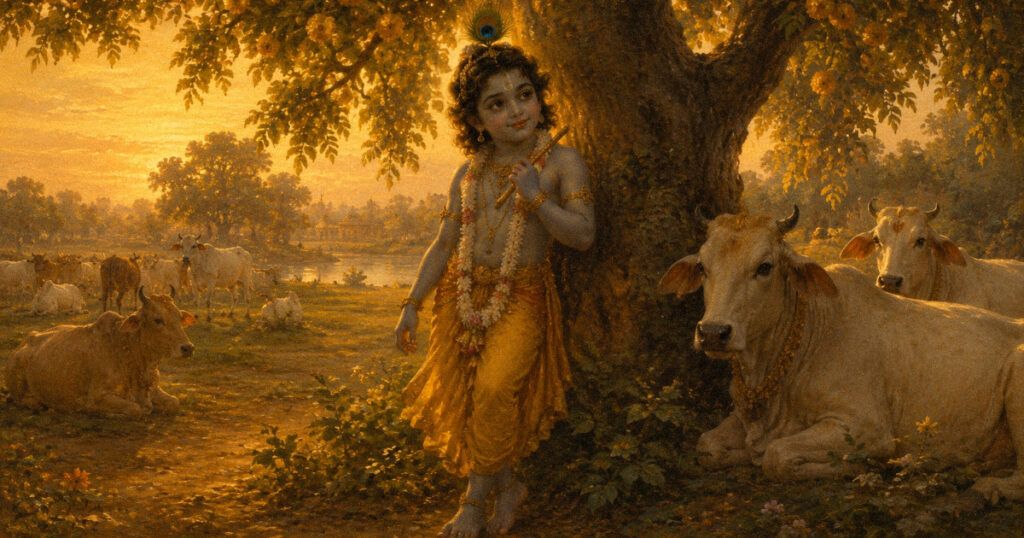
Venu means flute, and it is called madhura, sweet, in the masculine form. Renu means dust or pollen, often understood here as the sacred dust of Vrindavan that Krishna’s feet touch. Panih means hand, and padau means the two feet, in the dual form, since we have two feet. So this line moves from the flute, an object Krishna holds, to the dust beneath his feet, to his hands, and then to his feet themselves.
The flute is often read as a symbol of the surrendered human heart, since a flute is a hollow reed that only makes music when it empties itself and lets breath pass through it. Placing the flute right next to the dust of the ground, and then the hands and feet, brings together something exalted, music, and something extremely humble, dust, showing that in this hymn, nothing is too lowly to be called sweet.
Sanskrit line two: Nrityam madhuram sakhyam madhuram madhuradhipate akhilam madhuram.
Nrityam means dance. Sakhyam means friendship, specifically the easy, equal, playful friendship Krishna shared with the cowherd boys of Vrindavan, not a formal or distant relationship, but genuine companionship. This is one of the most important lines in the whole hymn for understanding Krishna’s approachability.
Sakhya bhava, the mood of friendship, is considered one of the five major ways a devotee can relate to Krishna in bhakti tradition, alongside peaceful reverence, servitude, parental love, and romantic love.
By calling friendship itself sweet, this line tells the devotee that they do not need to approach Krishna only with fear or formality. They can approach him the way you would approach a close friend.
Verse four: geetam madhuram peetam madhuram
Sanskrit line one: Geetam madhuram peetam madhuram bhuktam madhuram suptam madhuram.
Geetam means song or singing. Peetam means drinking, or what has been drunk. Bhuktam means eating, or what has been eaten. Suptam means sleep, or the state of being asleep. This line is remarkable because it takes the most ordinary bodily actions imaginable, eating, drinking, sleeping, and calls them sweet in exactly the same breath as singing, which is usually seen as an artistic and elevated act. There is no separation here between the sacred and the mundane.
The deeper Madhurashtakam meaning in this line is a very grounded one. It tells us that when a life is filled with love and awareness, even the most basic biological needs of the body, hunger, thirst, and rest, are transformed. This is a comforting idea for ordinary devotees, since it suggests that holiness is not only found in temples or in grand rituals, but can be found in an ordinary meal or an afternoon nap, if approached with the right heart.
Sanskrit line two: Roopam madhuram tilakam madhuram madhuradhipate akhilam madhuram.
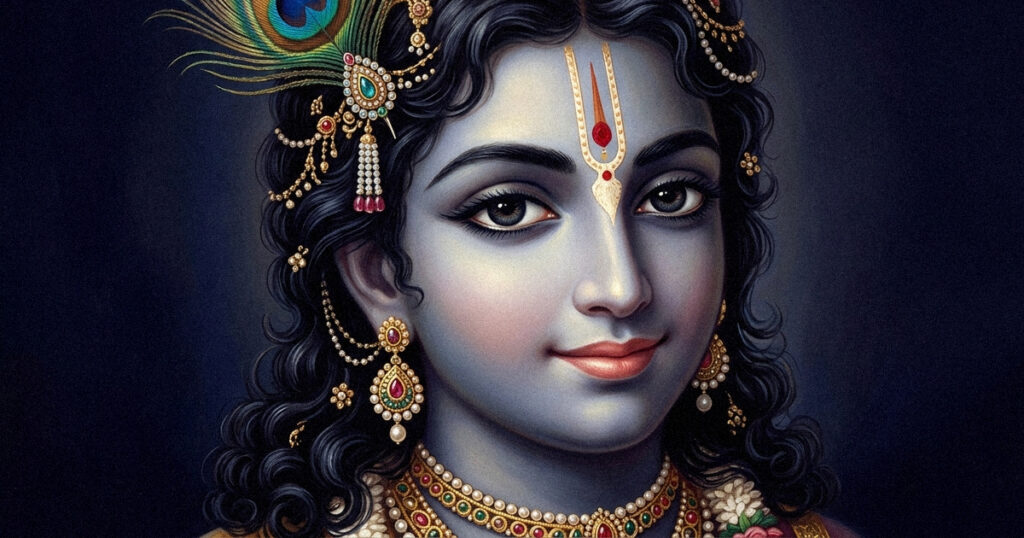
Roopam means form or physical beauty. Tilakam refers to the sacred mark applied to the forehead, usually made of sandalwood paste or kumkum, worn by devotees and deities alike as a sign of auspiciousness.
This line returns to appearance, but now with a small and specific detail, the tilak, rather than the whole face as in verse one. This shows the hymn’s pattern of zooming in and out, sometimes looking at the big picture, like the whole body or the whole day, and sometimes zooming into one tiny detail, like a mark on the forehead, and finding sweetness at every level of magnification.
Verse five: karanam madhuram taranam madhuram
Sanskrit line one: Karanam madhuram taranam madhuram haranam madhuram ramanam madhuram.
This verse is the boldest and most philosophically loaded in the entire hymn. Karanam means action or doing. Taranam means crossing over, or saving, often connected to the idea of Krishna helping devotees cross over the ocean of worldly suffering, samsara.
Haranam means taking away, stealing, or removing, which connects both to Krishna’s playful butter thefts and to his removing the burdens and sins of his devotees. Ramanam means enjoying, delighting, or engaging in play, often with romantic or joyful connotations, connected to the word Rama, meaning one who gives delight.
Here we see four different modes of Krishna’s activity placed side by side, plain action, saving, taking away, and delighting. This line makes the claim that whatever mode Krishna is acting in, whether he is simply doing something ordinary, or rescuing someone, or taking something from them, or enjoying himself, all of it carries the same sweetness. It removes any idea that some of Krishna’s actions are more sacred than others.
Sanskrit line two: Vamitam madhuram shamitam madhuram madhuradhipate akhilam madhuram.
This is the line that most people find surprising when they first study the Madhurashtakam meaning closely. Vamitam relates to vomiting or expelling, and shamitam means calming, pacifying, or bringing to an end, sometimes carrying the sense of destroying.
These two words are usually connected by commentators to the story of the demoness Putana, who tried to kill the infant Krishna by feeding him poisoned milk from her breast. Krishna drank the poison filled milk and, along with it, drew out her very life force, ending her, while she herself attained liberation through contact with him.
Calling this vamitam and shamitam madhuram is one of the most mature statements in all of bhakti literature. It says that even an act connected with poison, death, and the ending of a demon’s life is sweet, because it comes from Krishna and because it ultimately liberates rather than merely destroys.
The Madhurashtakam meaning here pushes the devotee to accept that Krishna’s grace can look frightening or strange from the outside, yet it remains grace all the same.
Verse six: gunja madhura mala madhura
Sanskrit line one: Gunja madhura mala madhura yamuna madhura veechi madhura.
This verse shifts the focus outward, away from Krishna’s body and actions, and onto the natural world connected to him. Gunja refers to small red and black seeds, often strung into garlands and bracelets worn by Krishna and the cowherds of Vrindavan. Mala means a garland, usually of flowers. Yamuna is the sacred river that flows through Vrindavan and features constantly in Krishna’s stories. Veechi means the waves or ripples of that river.
The line moves from something small and simple, a seed, to something more decorative, a flower garland, to something vast, an entire river, and then to the smallest visible motion of that river, its waves. This zooming out from a tiny seed to a whole river and back to its smallest ripple shows the same pattern of small and large details resting together that we saw earlier in verse three.
The Madhurashtakam meaning here is that sweetness is not confined to Krishna’s own body. It radiates outward into the objects he touches and the land he lives in, the way warmth from a fire spreads into a whole room rather than staying only in the flame.
Sanskrit line two: Salilam madhuram kamalam madhuram madhuradhipate akhilam madhuram.
Salilam means water in general. Kamalam means lotus. This line closes the natural imagery of the verse by mentioning plain water and then the lotus flower that grows from it, a flower deeply associated with Krishna, whose eyes are often compared to lotus petals in Sanskrit poetry.
Water, ordinary and everywhere, and the lotus, rare and beautiful, are placed together and called equally sweet, once again showing that nothing, however common, is left outside the reach of this sweetness.

Verse seven: gopi madhura leela madhura
Sanskrit line one: Gopi madhura leela madhura yuktam madhuram muktam madhuram.
Gopi refers to the cowherd women of Vrindavan, Krishna’s close devotees and companions, most famously represented by Radha. Leela means play or divine sport, the spontaneous, joyful activities Krishna engages in without any selfish motive. Yuktam means joined, united, or connected. Muktam means freed, released, or separated.
This line contains one of the most emotionally advanced ideas in the entire hymn. By placing yuktam, union, directly next to muktam, separation or release, in the very same breath, both experiences are declared equally sweet. In ordinary human experience, union with someone we love feels joyful and separation feels painful.
This line does not deny that difference, but it insists that within the framework of devotion, even the ache of separation from Krishna carries its own sweetness, because that longing itself is proof of a love so deep it hurts to be apart. This is the same emotional territory explored constantly in the stories of Radha’s longing for Krishna during his time away from Vrindavan.
Sanskrit line two: Dhrishtam madhuram srishtam madhuram madhuradhipate akhilam madhuram.
Dhrishtam means that which is seen, or the act of seeing itself. Srishtam means that which is created, or creation itself. This line widens the lens one final step within this verse, moving from the personal experience of union and separation to the very act of perception and the very fact of creation.
Simply seeing Krishna is called sweet, and the entire created universe, since it flows from him, is called sweet as well. This is a quiet but powerful theological claim, suggesting that all of creation is, at its root, an expression of the same sweetness found in Krishna himself.
Verse eight: gopa madhura gavo madhura
Sanskrit line one: Gopa madhura gavo madhura yashtir madhura srishtir madhura.
Gopa refers to the cowherd boys, Krishna’s playmates and friends. Gavo means cows, the animals so central to Krishna’s identity as Govinda, the protector of cows. Yashtih means a staff or stick, the simple herding staff carried by cowherds while tending their cattle. Srishtih here again means creation, repeated from the previous verse but now placed among the humblest possible company, cowherd boys, cows, and a wooden stick.
This is one of the most quietly radical lines in the whole hymn. It takes the least glamorous, most ordinary figures imaginable, simple village boys, farm animals, and a herding stick, and places them in the same sentence as srishtih, the entirety of creation. The Madhurashtakam meaning being taught here is direct and clear. Greatness and sweetness are not reserved for kings, gods, or grand cosmic forces. They live just as fully in a cowherd boy’s staff as they do in the universe itself, if you are looking with the eyes of devotion.
Sanskrit line two: Dalitam madhuram phalitam madhuram madhuradhipate akhilam madhuram.
Dalitam means that which is broken, split, or fallen, often understood here as fallen or overripe fruit lying on the ground. Phalitam means that which has borne fruit, or fruit still ripening on the tree. This final line before the closing refrain takes something most people would consider waste, a broken or fallen fruit, and calls it just as sweet as fruit still growing and thriving on its branch.
This is the hymn’s last and most complete statement. Even decay, even the end of something’s life cycle, even what looks discarded or finished, remains within the boundary of sweetness. Nothing, not even loss or ending, is excluded.
With this final line, the hymn closes exactly where it began, on the smallest and most physical details of the world, but having traveled through the body, the character, the actions, the surroundings, the companions, and the whole of creation to get there.
The Vedic astrology connection to madhurya, or sweetness
Sweetness, or madhurya, is not only a devotional idea. It also has a place in Vedic astrology. In Jyotish, Shukra, the planet Venus, governs love, beauty, art, romance, and all things pleasing to the senses. Shukra is considered the karaka, or significator, of madhurya bhava, the emotional sweetness that draws people towards beauty and affection. When Shukra is strong in a birth chart, a person is often drawn towards devotional love, music, poetry, and the kind of soft hearted worship that the Madhurashtakam expresses so fully.
There is also a link worth noting between Chandra, the Moon, and Krishna. The Moon rules the mind and emotions in Vedic astrology, and Krishna is often called Chandravadana, one whose face is like the moon. The Moon’s light is soft, cool, and pleasing rather than harsh, much like the emotional quality this hymn is trying to capture. Just as Chandra governs the tides of feeling within a person, Vallabhacharya’s hymn tries to pull the reader’s feelings gently towards Krishna, line by line, the way moonlight pulls the ocean without any force at all.
Even the number eight, ashta, carries meaning in Vedic thought. Eight is connected to Shani, Saturn, the planet of structure, discipline, and steady repetition. It is worth noticing that a hymn about overflowing, spontaneous love is built inside a very disciplined structure of exactly eight verses, each with the same closing refrain repeated without fail. This is a reminder that even the most emotional forms of devotion in Vedic tradition are held inside a careful and repeated structure, much like a mantra.