Kaal Bhairav Ashtakam: Meaning, Origin Story, Benefits and Lyrics
The Kaal Bhairav Ashtakam is one of the most powerful hymns in Hindu devotional tradition, dedicated to Lord Kaal Bhairav, the fierce and time-conquering form of Lord Shiva. This eight verse Sanskrit prayer has been recited by devotees for centuries, and it continues to hold a special place in Shaiva worship today. If you have ever wondered what makes this hymn so revered, where it came from, and how it can help you in daily life, this article will walk you through everything in simple terms.
Who Is Kaal Bhairav and Why Does He Matter
Before understanding the hymn itself, it helps to know who Kaal Bhairav actually is. The name comes from two Sanskrit words: Kaal, meaning time or death, and Bhairav, meaning fearsome. Put together, Kaal Bhairav means the one who is beyond the reach of time and death itself. He is considered a fierce manifestation of Lord Shiva, and in this form, Shiva takes on a wrathful yet protective character.
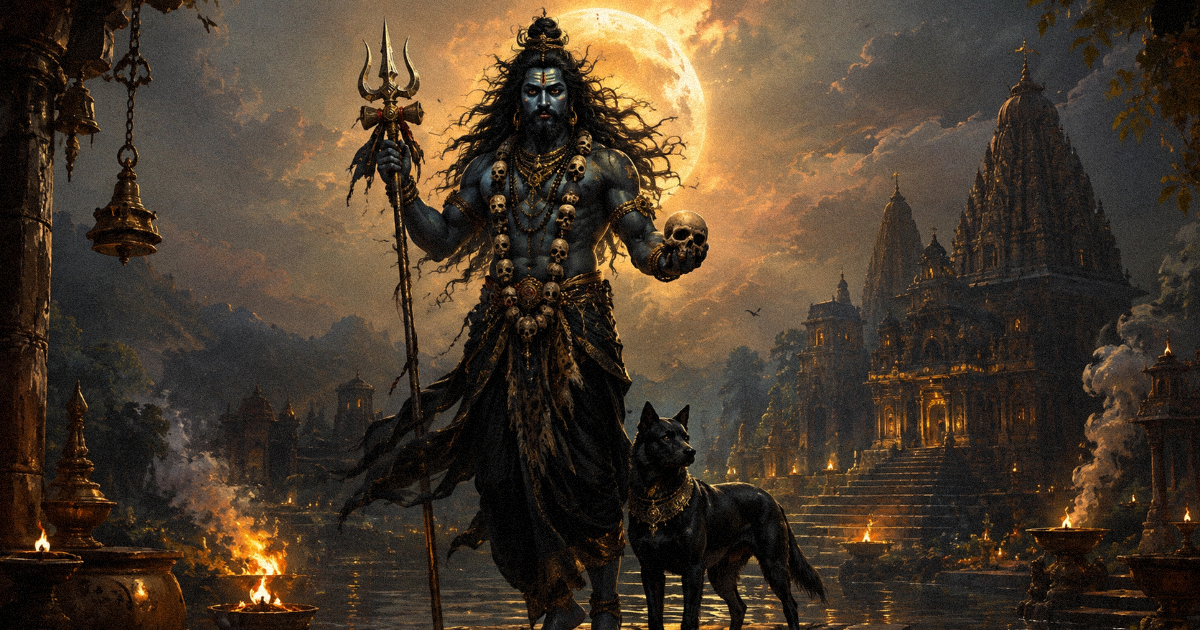
Kaal Bhairav is regarded as the guardian deity of Kashi, the ancient city also known as Varanasi. Devotees believe that he holds the keys to spiritual liberation in this sacred city, and no soul can attain moksha in Kashi without his blessing. He is often depicted as dark complexioned, unclothed, adorned with a garland of skulls, holding weapons in his four hands, and accompanied by a dog, which is considered his vahana or vehicle.
The Origin Story Behind Kaal Bhairav
The story of how Kaal Bhairav came into being is rooted in the Shiva Purana. According to this tale, Lord Brahma once grew arrogant and proud, believing himself to be the supreme creator above all other gods. To humble him and correct this ego, Lord Shiva manifested in his fierce form as Kaal Bhairav and severed one of Brahma’s five heads. This head represented Brahma’s pride and ego.
However, this act of cutting off a divine head, even for a righteous reason, brought upon Kaal Bhairav the sin of Brahmahatya, the killing of a Brahmin. As a consequence, the skull remained stuck to his hand, and he was forced to wander the earth as a penitent, begging for alms with the skull as his begging bowl. His wanderings eventually led him to the city of Kashi, where he was finally freed from this curse. From that moment onward, Kaal Bhairav became the eternal guardian of Kashi, ensuring that sin cannot touch those who reside in or visit the holy city.
Adi Shankaracharya and the Composition of the Hymn
The Kaal Bhairav Ashtakam itself is credited to Adi Shankaracharya, the great philosopher and saint who lived around the eighth century CE and is widely known for reviving and spreading Advaita Vedanta across India. Adi Shankaracharya travelled extensively, engaging in debates and discourses, and organizing the Dashnami monastic order that still exists today in the form of ten akharas. He is said to have authored more than two hundred and fifty spiritual texts, and the Kaal Bhairav Ashtakam is among his most celebrated compositions.
It is believed that Adi Shankaracharya composed this hymn during his visit to Kashi, drawing inspiration from the descriptions of Bhairava found in the Shiva Purana and various Tantric texts. Each of the eight verses paints a vivid picture of Kaal Bhairav’s form, his divine attributes, and his role as the protector of dharma and the ruler of time.
Benefits of Chanting the Kaal Bhairav Ashtakam
Adi Shankaracharya himself included a phala shruti, a declaration of benefits, at the end of the hymn. According to this, those who recite the Kaal Bhairav Ashtakam with devotion are said to experience the following:
Freedom from shoka, which means grief and sorrow. Relief from moha, or delusion and unhealthy attachment. Release from dainya, a mindset rooted in poverty and lack. Reduction of lobha, meaning greed. Control over kopa, or anger. Relief from tapa, which refers to suffering and mental heat.
Beyond these, devotees also chant the Kaal Bhairav Ashtakam for protection from negative energies and black magic, relief from debt and legal troubles, courage to face enemies and obstacles, favorable outcomes in travel and business dealings, and the attainment of the eight siddhis, which are considered mystical powers in yogic tradition.
Many also believe that regular recitation heightens awareness at the Agya Chakra, the seat of intuition and knowledge located between the eyebrows, leading the devotee closer to a state of deep meditative absorption.
When and How to Chant the Kaal Bhairav Ashtakam
The most favorable time to chant the Kaal Bhairav Ashtakam is during the early morning hours or at midnight. Kaal Ashtami, which falls on the eighth day of the Krishna Paksha every month, is considered the most auspicious day for this practice.
Tuesdays and Sundays are also thought to be favorable. Devotees typically chant the hymn once, three times, or eleven times in a single sitting, depending on their capacity and intent. It is often recited in front of an image or idol of Bhairav, sometimes accompanied by incense, a mustard oil lamp, and offerings of black sesame seeds.
Precautions to Keep in Mind
While the Kaal Bhairav Ashtakam is a hymn of protection and grace, it is still associated with a fierce and intense deity, so certain precautions are traditionally advised. It is best to maintain physical and mental cleanliness before chanting, ideally after bathing and in a calm state of mind. Alcohol, meat, and other tamasic influences are generally avoided close to the time of recitation, even though some tantric traditions involve such offerings in specific ritual contexts that are not meant for casual practice.
Chanting should be approached with sincerity and respect rather than as a mechanical exercise, since this hymn calls upon an intense and powerful energy. If you are new to this practice, it is wise to start slowly, perhaps once a day, and to learn the correct pronunciation of the Sanskrit verses so that the rhythm and meaning are preserved.
The Kaal Bhairav Ashtakam in Sanskrit with Meaning
Here is the complete Kaal Bhairav Ashtakam, presented verse by verse with its meaning in simple English.
Verse 1
देवराजसेव्यमानपावनांघ्रिपङ्कजं व्यालयज्ञसूत्रमिन्दुशेखरं कृपाकरम् ।
नारदादियोगिवृन्दवन्दितं दिगंबरं काशिकापुराधिनाथकालभैरवं भजे ॥ १॥
I worship Kaal Bhairav, Lord of Kashi, whose sacred lotus feet are honored by Indra himself, who wears a serpent as his sacred thread, carries the moon on his head, is full of compassion, and is worshipped by sages like Narada, and who remains unclothed, beyond all material bounds.
Verse 2
भानुकोटिभास्वरं भवाब्धितारकं परं नीलकण्ठमीप्सितार्थदायकं त्रिलोचनम् ।
कालकालमंबुजाक्षमक्षशूलमक्षरं काशिकापुराधिनाथकालभैरवं भजे ॥ २॥
I worship Kaal Bhairav, who shines with the brilliance of a million suns, who ferries devotees across the ocean of worldly existence, whose throat is blue, who fulfills every sincere desire, who has three eyes, who is the conqueror of time itself, lotus eyed, and the eternal wielder of the trident.
Verse 3
शूलटंकपाशदण्डपाणिमादिकारणं श्यामकायमादिदेवमक्षरं निरामयम् ।
भीमविक्रमं प्रभुं विचित्रताण्डवप्रियं काशिकापुराधिनाथकालभैरवं भजे ॥ ३॥
I worship Kaal Bhairav, the original cause behind all creation, dark complexioned, the primal deity, imperishable and free from all ailments, immensely powerful, the supreme lord, and one who delights in the wondrous cosmic dance known as Tandava.
Verse 4
भुक्तिमुक्तिदायकं प्रशस्तचारुविग्रहं भक्तवत्सलं स्थितं समस्तलोकविग्रहम् ।
विनिक्वणन्मनोज्ञहेमकिङ्किणीलसत्कटिं काशिकापुराधिनाथकालभैरवं भजे॥ ४॥
I worship Kaal Bhairav, who grants both worldly enjoyment and final liberation, whose form is beautiful and praiseworthy, who is deeply affectionate toward his devotees, who embodies the entire universe within himself, and whose golden waist belt tinkles with a pleasing sound.
Verse 5
धर्मसेतुपालकं त्वधर्ममार्गनाशनं कर्मपाशमोचकं सुशर्मधायकं विभुम् ।
स्वर्णवर्णशेषपाशशोभितांगमण्डलं काशिकापुराधिनाथकालभैरवं भजे ॥ ५॥
I worship Kaal Bhairav, the protector of the bridge of righteousness, the destroyer of unrighteous paths, the one who releases devotees from the bonds of karma, the giver of true happiness, whose radiant golden form is adorned with a serpent wrapped gracefully around his limbs.
Verse 6
रत्नपादुकाप्रभाभिरामपादयुग्मकं नित्यमद्वितीयमिष्टदैवतं निरंजनम् ।
मृत्युदर्पनाशनं करालदंष्ट्रमोक्षणं काशिकापुराधिनाथकालभैरवं भजे ॥ ६॥
I worship Kaal Bhairav, whose feet shine beautifully with jeweled sandals, who is eternal and without equal, the chosen deity of his devotees, pure and untouched by impurity, the one who crushes the pride of death itself, and whose fierce fangs grant liberation.
Verse 7
अट्टहासभिन्नपद्मजाण्डकोशसंततिं दृष्टिपात्तनष्टपापजालमुग्रशासनम् ।
अष्टसिद्धिदायकं कपालमालिकाधरं काशिकापुराधिनाथकालभैरवं भजे ॥ ७॥
I worship Kaal Bhairav, whose thunderous laughter shattered the cosmic egg created by Brahma, whose mere glance destroys entire networks of sin, who governs the wicked with a strict and fierce rule, who grants the eight mystical siddhis, and who wears a garland made of skulls.
Verse 8
भूतसंघनायकं विशालकीर्तिदायकं काशिवासलोकपुण्यपापशोधकं विभुम् ।
नीतिमार्गकोविदं पुरातनं जगत्पतिं काशिकापुराधिनाथकालभैरवं भजे ॥ ८॥
I worship Kaal Bhairav, leader of the spirit hosts, bestower of vast and lasting fame, the purifier of both merits and sins for all who dwell in Kashi, knower of the true path of righteousness, ancient and eternal ruler of the entire universe.
Phala Shruti (The Declaration of Benefits)
कालभैरवाष्टकं पठंति ये मनोहरं ज्ञानमुक्तिसाधनं विचित्रपुण्यवर्धनम् ।
शोकमोहदैन्यलोभकोपतापनाशनं प्रयान्ति कालभैरवांघ्रिसन्निधिं नरा ध्रुवम् ॥
Those who recite this beautiful Kaal Bhairav Ashtakam, which is a means to wisdom and liberation and which steadily increases merit, destroy their sorrow, delusion, poverty consciousness, greed, anger, and mental suffering, and surely attain closeness to the divine feet of Kaal Bhairav.
Closing Thoughts
The Kaal Bhairav Ashtakam is far more than a set of Sanskrit verses. It carries within it the story of humility taught to even the mightiest gods, the promise of protection for those who seek refuge in Kashi, and a path toward inner steadiness for anyone willing to chant it with sincerity.
Whether you are drawn to it for its poetic beauty, its philosophical depth, or its promised benefits, approaching the Kaal Bhairav Ashtakam with patience and respect can make it a meaningful part of your daily spiritual practice.