Lagna in Vedic Astrology: The Complete Guide
What Is a Lagna in Vedic Astrology and Why Does It Matter More Than Your Sun Sign?
In Vedic astrology, no single factor is more foundational than the Lagna. Every classical text, from the Brihat Parashara Hora Shastra to the Phaladeepika, places the Lagna at the very centre of chart interpretation. And yet, among those who are new to Jyotish, the Lagna is also one of the most consistently misunderstood concepts.
It is conflated with personality types, reduced to a simple label, and sometimes treated as though it were interchangeable with the Western notion of the sun sign or even the rising sign in the pop-astrology sense. None of those comparisons fully captures what the Lagna actually represents in the depth of the Vedic system.
What Is Lagna in Vedic Astrology?
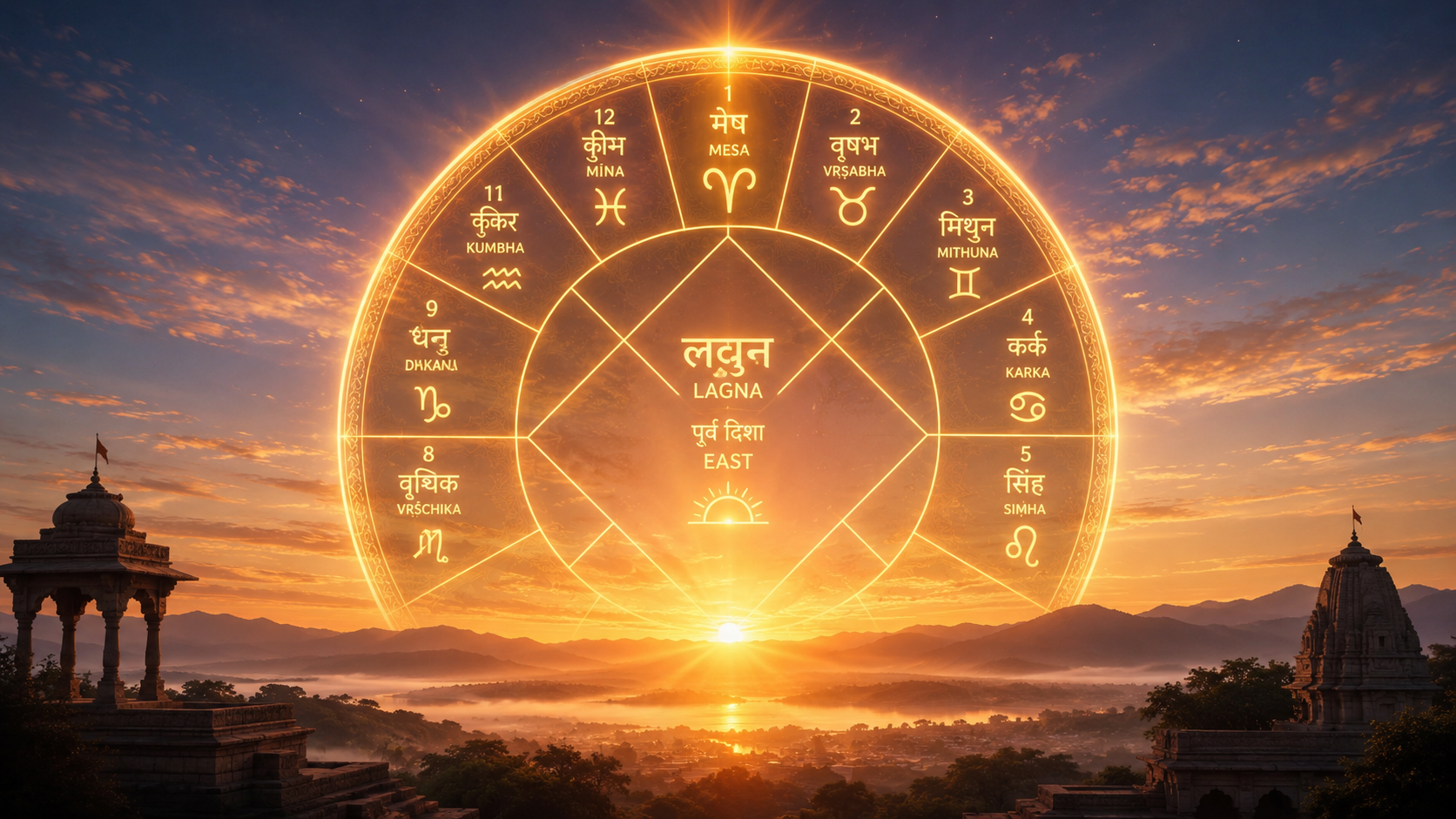
The word Lagna comes from the Sanskrit root lagn, which means to attach, to be fixed to, or to meet. In an astronomical sense, the Lagna is the exact degree of the zodiac that was rising on the eastern horizon at the precise moment, date, and geographical location of a person’s birth. As the Earth rotates on its axis, the entire band of the zodiac appears to rotate around us.
At any given moment, one of the twelve signs of the zodiac is crossing the eastern horizon. The sign that is rising at the moment of birth becomes that person’s Lagna, and the precise degree within that sign becomes the Lagna degree or Lagna Spashta.
Because the Earth completes one full rotation in approximately 24 hours and there are twelve zodiac signs, each sign spends roughly two hours on the eastern horizon on average. However, this is an approximation. The actual duration varies significantly based on the sign, the time of year, and, critically, the geographical latitude of the place of birth. Signs with shorter ascensional times, such as Aries and Pisces in northern latitudes, may take only 90 to 100 minutes to rise, while signs like Virgo and Libra can take well over two hours.
This is why the exact time of birth, down to the minute, and the precise place of birth are both essential for calculating the Lagna accurately.
In classical Jyotish, the Lagna is formally called the Janma Lagna (the ascendant at birth) and it defines the entire structure of the twelve houses in a horoscope. The sign rising at birth becomes the first house. The next sign becomes the second house, and so on through all twelve. Everything else in a Vedic birth chart is organised around this single reference point.
The Lagna as the First House: The Foundation of the Entire Chart
The first house in a Vedic birth chart is not merely one of twelve equal slices. It is the anchor of the entire horoscope. The classical texts describe the first house as the Tanu Bhava, the house of the physical body, the self, personal identity, temperament, constitution, general vitality, and one’s approach to life. But the significance of the Lagna extends far beyond these keywords.
The Lagna is the lens through which the entire chart is read. Every planet in the chart operates in relation to the Lagna. A planet’s strength, beneficence, or maleficence toward a native is judged not only by its sign placement and nakshatra but also by its relationship to the Lagna. For example, Jupiter is a natural benefic, but for a Taurus Lagna or a Libra Lagna, Jupiter rules the eighth and eleventh or the third and sixth houses respectively, both of which include some of the more challenging house lordships.
In such cases, Jupiter does not function as a straightforward benefic. Its results are coloured by the house it rules from the Lagna. This is the foundational concept of functional benefics and malefics, and it is entirely dependent on the Lagna.
Similarly, yoga formations in a chart, those powerful combinations of planets that produce extraordinary results, are defined and assessed primarily in relation to the Lagna. The famous Rajayoga, which indicates wealth, status, and authority, requires the lord of a Kendra (first, fourth, seventh, or tenth house) and the lord of a Trikona (first, fifth, or ninth house) to be connected.
The first house is both a Kendra and a Trikona, making the Lagna lord particularly important in yoga formation. Without knowing the Lagna, you cannot identify functional house lords, and without functional house lords, you cannot accurately assess yogas.
What the Lagna Is Not: Critical Misconceptions to Unlearn
Before going further into the nature of individual Lagnas, it is worth addressing the misconceptions that cause the most confusion in practice, particularly for those coming to Vedic astrology from a Western astrology background or from popular horoscope culture.
Misconception 1: The Lagna Is the Same as the Western Rising Sign
On the surface, the Lagna appears identical to the Western rising sign. Both refer to the sign rising on the eastern horizon at the time of birth. However, the critical difference lies in the zodiac being used. Western astrology uses the Tropical zodiac, which is based on the seasons and is fixed to the vernal equinox. Vedic astrology uses the Sidereal zodiac, which is based on the actual positions of the stars.
Due to the slow wobble of the Earth’s axis, a phenomenon known as the precession of the equinoxes, the tropical and sidereal zodiacs have drifted approximately 23 to 24 degrees apart (this difference is called Ayanamsha). As a result, many people find that their Vedic Lagna is a different sign from their Western rising sign. A person who appears to have a Libra rising in Western astrology may in fact have a Virgo Lagna in Vedic astrology. The interpretation, house lordships, and yogas that flow from these are entirely different.
Misconception 2: The Lagna Describes Your Personality Completely
One of the most damaging oversimplifications in popular astrology is the habit of reducing a person to their ascendant sign. You will find articles claiming that “all Scorpio Lagna people are secretive and intense” or “all Sagittarius Lagna people are philosophical and freedom-loving.” This is astrological shorthand that, at best, captures only a fragment of the truth and, at worst, creates rigid and inaccurate boxes.
The Lagna sign gives you the starting framework for the first house. But the Lagna lord (the planet that rules the sign of the Lagna), its placement by sign, house, nakshatra, and dignity, the planets aspecting or conjoining the Lagna degree, and the planets sitting in the first house itself all modify, strengthen, or redirect the baseline energy of the Lagna sign.
A Leo Lagna with the Sun (the Lagna lord) placed in the twelfth house in Cancer, debilitated or combust, will express itself very differently from a Leo Lagna with the Sun exalted in Aries in the ninth house. Calling both simply “Leo Lagna personalities” and attributing the same traits to them is fundamentally inaccurate.
Misconception 3: The Lagna Is More Important Than Everything Else
While the Lagna is the structural foundation of the chart, classical Jyotish does not teach that it overrides all other factors. Experienced astrologers read the chart through multiple simultaneous lenses. The Chandra Lagna (the chart cast with the Moon’s sign as the first house) is given enormous importance in Vedic astrology, sometimes considered equally or even more important for assessing the mind, emotions, and daily life patterns.
The Surya Lagna (chart from the Sun) is used for matters related to the soul’s purpose and authority. The Arudha Lagna (a derived point that shows how the world perceives you, as distinct from who you actually are) adds another essential dimension. Advanced Vedic astrology also employs divisional charts (Varga charts), each of which has its own Lagna, used for specific life domains such as marriage (Navamsha Lagna), career (Dashamsha Lagna), and children (Saptamsha Lagna). None of these operates in isolation.
Misconception 4: Your Lagna Sign Is the “Real You” While Your Sun Sign Is Superficial
In reaction to Western sun-sign astrology, some students of Jyotish swing to the other extreme and dismiss the Sun sign entirely, treating the Lagna as the only marker worth considering. This is equally incorrect. In Vedic astrology, the Sun represents the Atma (soul), authority, vitality, the father, and the higher self. The Moon represents the mind, emotional nature, and habits.
The Lagna represents the physical body, the overall life force, and the lens of experience. All three are distinct and separately important. The classical tradition never asks you to choose between them.
Misconception 5: A Lagna in an Exalted Sign Is Always Better
Another common error is assuming that having a Lagna in a sign where the Lagna lord is exalted automatically makes for a stronger or happier life. The condition of the Lagna lord matters enormously, but exaltation is not the only relevant factor. A planet can be exalted and still be afflicted by malefic aspects, placed in a dusthana (sixth, eighth, or twelfth house), or in a nakshatra whose lord is severely weakened.
Conversely, a Lagna lord that is technically in a friendly sign or even in its own sign, well-placed and aspected by benefics, can produce outstanding results even without formal exaltation. Chart reading in Jyotish is a holistic, integrative process, not a checklist of individual dignities.
The Lagna Lord: The Most Important Planet in Any Chart
Every sign of the zodiac has a ruling planet. Aries is ruled by Mars, Taurus by Venus, Gemini by Mercury, Cancer by the Moon, Leo by the Sun, Virgo by Mercury, Libra by Venus, Scorpio by Mars (with some traditions also assigning Ketu as a co-ruler), Sagittarius by Jupiter, Capricorn by Saturn, Aquarius by Saturn (with Rahu as a co-ruler in many traditions), and Pisces by Jupiter.
The planet that rules the sign of your Lagna is called the Lagna lord or Lagnesh. This planet is considered the most important planet in the entire natal chart, regardless of where it is placed or how it is dignified. The reason is straightforward: the Lagna represents the native as a whole, the body, the life force, the overall trajectory of existence, and the Lagna lord is the primary governor of all these things.
The placement of the Lagna lord by house reveals where the native’s primary life energy flows and where much of their life story will unfold. A Lagna lord in the tenth house tends to direct a person’s identity strongly toward career and public life. A Lagna lord in the fifth house inclines the native toward creativity, children, learning, and dharmic pursuits.
A Lagna lord in the twelfth house can indicate foreign connections, spiritual retreat, or significant expenditure of life energy in hidden or secluded environments. These are broad principles that must always be read in the context of the full chart.
The aspects received by the Lagna lord from other planets add further layers. A Lagna lord conjunct or aspected by Jupiter in a strong position tends to bring wisdom, grace, and expansion to the native’s life expression. A Lagna lord closely afflicted by Saturn or Rahu may produce persistent life challenges that require sustained effort to overcome. These are not judgments about a person’s worth; they are descriptions of the terrain they are navigating.
All 12 Lagna in Vedic Astrology: Characteristics, Strengths, and Life Themes
Each of the twelve Lagnas carries the qualities of its sign and, importantly, is governed by the planet that rules that sign. What follows is an in-depth treatment of each Lagna as it is understood in the classical Vedic tradition, along with the strengths it confers, the challenges it creates, and the nuances that popular descriptions tend to overlook.
1. Mesha Lagna (Aries Ascendant)
Lagna Lord: Mars (Mangal)
Mesha is a fire sign, the first of the zodiac, cardinal in nature, and ruled by Mars. The Lagna itself is the first house, making Mars the Lagna lord and also the eighth house lord (since Scorpio, also ruled by Mars, is the eighth sign from Aries). This dual ownership is significant: the Lagna lord rules a maraka-adjacent position in addition to the first house, which gives Mesha Lagna people an inherent relationship with risk, intensity, and transformation.
Mesha Lagna individuals tend to have strong physical constitutions, a direct manner, and a natural drive toward action. They are initiators rather than sustainers. The Sun is exalted in Aries, making the Sun a natural ally for this Lagna. Jupiter rules the ninth and twelfth houses from Aries, making it a functional benefic.
Venus, as lord of the second and seventh, holds dual maraka lordship and should be treated with care despite being a natural benefic. Saturn rules the tenth and eleventh houses, making it a Yogakaraka for Mesha Lagna, that is, a single planet capable of producing Raja Yoga on its own.
The common mischaracterisation of Mesha Lagna as simply “aggressive” or “impatient” misses the deeper quality of this Lagna: a genuine courage and willingness to break new ground that, when channelled with awareness, makes these individuals natural pioneers.
2. Vrishabha Lagna (Taurus Ascendant)
Lagna Lord: Venus (Shukra)
Vrishabha is an earth sign, fixed in nature, and ruled by Venus. The Moon is exalted in Taurus, giving an innate affinity between this Lagna and emotional stability, aesthetic sensitivity, and an appreciation for beauty and material comfort. Venus as Lagna lord also rules the sixth house (Libra), which makes Venus a somewhat mixed significator: strong for the self and body but also connected to opposition, service, and debts.
Saturn, as lord of the ninth and tenth, is the Yogakaraka for Vrishabha Lagna, capable of producing exceptional success through disciplined, sustained effort. Jupiter, however, rules the eighth and eleventh, which are not among the most auspicious house combinations for Jupiter to hold, somewhat reducing its benefic potential for this Lagna.
Vrishabha Lagna individuals are often characterised by patience, steadiness, and an instinct for quality in everything from food to relationships to work. The shadow side is resistance to change, which can slide into stubbornness when challenged. What popular descriptions miss is the profound sensory intelligence these natives carry: a capacity to read environments through feeling and intuition that is quite different from intellectual analysis.
3. Mithuna Lagna (Gemini Ascendant)
Lagna Lord: Mercury (Budha)
Mithuna is an air sign, mutable, and ruled by Mercury. Mercury also rules the fourth house from Gemini (Virgo), making it both Lagna lord and fourth house lord, a combination that connects self-expression with home, mother, and emotional foundations. Mercury in Vedic astrology is a planet of intellect, language, commerce, adaptability, and analytical precision.
For Mithuna Lagna, Venus is an important functional benefic, ruling the fifth and twelfth. Saturn rules the eighth and ninth, making it a somewhat ambivalent planet: difficult for longevity-related matters but good for fortune when functioning well. Jupiter rules the seventh and tenth, giving it maraka lordship alongside Kendra ownership, a double-edged quality that classical texts note carefully.
Mithuna Lagna individuals are naturally curious, communicative, and quick to adapt. They often have a gift for language, writing, or teaching. The deeper quality that popular descriptions tend to overlook is the Mithuna Lagna’s genuine desire for synthesis: these natives do not merely collect information but are driven to find connections between disparate ideas and create something cohesive from them. The challenge is following through when initial excitement fades.
4. Karka Lagna (Cancer Ascendant)
Lagna Lord: Moon (Chandra)
Karka is a water sign, cardinal in nature, and the only sign ruled by the Moon. This makes Karka Lagna one of the most emotionally sensitive Lagnas in the zodiac. The Moon as Lagna lord is deeply personal: it governs the mind, the mother, nourishment, fluids, the public, and cyclical rhythms. Because the Moon changes signs every two and a half days, the emotional state and general life tone of Karka Lagna natives can be unusually responsive to lunar cycles.
Mars rules the fifth and tenth from Cancer, making it a powerful Yogakaraka for this Lagna. Jupiter rules the sixth and ninth, a mixed combination that gives Jupiter good fortune but also a subtle connection to challenge. Saturn rules the seventh and eighth, placing it among the maraka significators for Karka Lagna.
Karka Lagna individuals are often deeply caring, intuitive, and attuned to the emotional undercurrents of any situation. They have a natural talent for nurturing others and a strong bond with home, family, and ancestral roots. The persistent mischaracterisation of this Lagna as “overly emotional” or “clingy” overlooks the profound perceptive intelligence that comes with this sensitivity. Karka Lagna natives often know things they cannot explain rationally, and this knowing, when trusted, rarely leads them astray.
5. Simha Lagna (Leo Ascendant)
Lagna Lord: Sun (Surya)
Simha is a fire sign, fixed in nature, and the only sign ruled by the Sun. The Sun as Lagna lord brings qualities of leadership, authority, dignity, clarity of purpose, and a natural orientation toward dharma. The Sun represents the individual soul (Atma), and Simha Lagna individuals therefore tend to have a strong sense of individual identity and a deep need for authentic self-expression.
Mars rules the fourth and ninth from Leo, making it a Yogakaraka for this Lagna: one of the most beneficial planetary combinations possible. Jupiter rules the fifth and eighth, mixing its dharmic fifth house role with the difficult eighth house, requiring careful assessment. Saturn, as lord of the sixth and seventh, carries maraka lordship and functions as a natural adversary to the Sun-ruled Lagna in many respects.
Simha Lagna natives are often dignified, generous, and natural leaders who carry themselves with a quiet or overt sense of authority. What is regularly misunderstood about this Lagna is that the need for recognition, which many describe condescendingly as vanity, is actually a deep spiritual need for the Atma to be acknowledged in its authentic form. When the Simha Lagna native is not seen or valued, the wound is existential rather than merely ego-based.
6. Kanya Lagna (Virgo Ascendant)
Lagna Lord: Mercury (Budha)
Kanya is an earth sign, mutable in nature, and ruled by Mercury. Like Mithuna, Kanya Lagna is governed by Mercury, but the expression differs considerably. Where Mithuna Mercury is communicative and curious, Kanya Mercury is analytical, discriminating, and detail-oriented. Kanya Lagna is associated with refinement, service, precision, and the capacity to identify what needs to be improved in any system or situation.
Mercury also rules the tenth house from Virgo (Gemini), making it both Lagna lord and tenth house lord, a very powerful combination for career-related success when Mercury is strong. Venus rules the second and ninth, making it a functional benefic and connected to wealth and fortune. Saturn rules the fifth and sixth, giving it a mixed portfolio but generally considered capable of producing good results for the fifth house in particular. Mars rules the third and eighth, connecting it to the dusthanas and making it a planet that requires careful handling for this Lagna.
Kanya Lagna individuals are often precise, service-oriented, and gifted at seeing what others overlook. They have a strong capacity for sustained, methodical work and often excel in fields requiring detailed expertise. The common mischaracterisation of this Lagna as “critical” or “perfectionist” applies to the shadow expression. At its highest, Kanya Lagna produces individuals whose attention to detail is an act of deep care for the quality of whatever they are contributing to.
7. Tula Lagna (Libra Ascendant)
Lagna Lord: Venus (Shukra)
Tula is an air sign, cardinal in nature, and ruled by Venus. Saturn is exalted in Libra, which gives Saturn a natural dignity in this sign and makes Saturn one of the most beneficial planets for Tula Lagna natives. Saturn rules the fourth and fifth from Libra, a combination that makes it a Yogakaraka: capable of producing exceptional results related to home, education, intelligence, and creativity.
Venus as Lagna lord also rules the eighth house (Taurus), which means, as with Vrishabha Lagna, the Lagna lord carries a connection to the eighth house. Jupiter rules the third and sixth, both difficult houses in the dusthana or upachaya category depending on context, which means Jupiter does not function as a natural benefic for this Lagna in the way it does for some others. Mars rules the second and seventh, placing it among the maraka lords for Tula Lagna.
Tula Lagna individuals are typically socially gifted, aesthetically aware, and skilled at creating harmony between opposing perspectives. They have a genuine talent for diplomacy and a strong sense of fairness. The common mischaracterisation of this Lagna as “indecisive” misses the actual dynamic: Tula Lagna natives are not failing to decide. They are genuinely processing multiple valid perspectives simultaneously, which is an intellectual and ethical strength that impatient observers mistake for weakness.
8. Vrishchika Lagna (Scorpio Ascendant)
Lagna Lord: Mars (Mangal), with Ketu as co-ruler in many classical traditions
Vrishchika is a water sign, fixed in nature, and one of the most misrepresented Lagnas in popular astrology. Mars as Lagna lord also rules the sixth house from Scorpio (Aries), making Mars both the self-significator and the lord of an adversarial house. This creates an interesting internal tension: the Vrishchika Lagna individual’s drive and energy (Mars as Lagna lord) are always in dialogue with the challenges and obstacles they must navigate (Mars as sixth lord).
Jupiter rules the second and fifth from Scorpio, making it a highly beneficial planet for this Lagna, governing both wealth and intelligence or progeny. The Moon rules the ninth house, connecting it to fortune and dharma. Saturn rules the third and fourth, placing it in an ambivalent position but not among the strongest benefics for this Lagna.
Vrishchika Lagna individuals possess extraordinary psychological depth, perceptiveness, and a capacity for transformation that few other Lagnas match. They are rarely what they appear on the surface. The persistent characterisation of this Lagna as “secretive,” “manipulative,” or “obsessive” is a caricature.
At its core, Vrishchika Lagna carries an intense relationship with the truth beneath the surface: these natives tend to see through pretence instinctively and seek genuine encounter rather than social performance. This can be unsettling to those who prefer comfortable superficiality.
9. Dhanu Lagna (Sagittarius Ascendant)
Lagna Lord: Jupiter (Guru)
Dhanu is a fire sign, mutable in nature, and ruled by Jupiter. Jupiter as Lagna lord also rules the fourth house from Sagittarius (Pisces), making it the lord of two highly auspicious positions: the first (body and self) and the fourth (home, mother, emotional foundations, and inner peace). This is one of the reasons classical texts consider Dhanu Lagna to carry a naturally dharmic and expansive quality.
Mars rules the fifth and twelfth from Sagittarius. As fifth lord, Mars is particularly significant: the fifth house rules intelligence, creativity, devotion, past karma, and progeny, and Mars’s rulership here gives Dhanu Lagna individuals considerable creative and intellectual drive. Saturn rules the second and third, placing it in a somewhat difficult position. Sun rules the ninth house, making it a highly auspicious planet that governs fortune and connects the native to their father and higher authority.
Dhanu Lagna individuals often have a genuine philosophical curiosity and a need to understand the larger picture. They are drawn to teaching, travel, spiritual inquiry, and the expansion of horizons in whatever domain they inhabit. The common mischaracterisation of this Lagna as “preachy” or “overconfident” reflects the shadow of a Jupiter that is poorly placed or afflicted. When Jupiter functions well, the Dhanu Lagna individual shares wisdom not from superiority but from genuine love of understanding.
10. Makara Lagna (Capricorn Ascendant)
Lagna Lord: Saturn (Shani)
Makara is an earth sign, cardinal in nature, and ruled by Saturn. Mars is exalted in Capricorn, which gives Mars a particular strength in this sign. Saturn as Lagna lord also rules the second house from Capricorn (Aquarius), connecting the self-significator to accumulated wealth, speech, and family lineage. Saturn ruling both the Lagna and the second house means that for Makara Lagna, the primary life themes of discipline, responsibility, patience, and endurance are intertwined with material security and the way one communicates.
Venus rules the fifth and tenth from Capricorn, making it the Yogakaraka for this Lagna: a planet capable of producing Raja Yoga on its own. When Venus is strong and well-placed for Makara Lagna, the results for career, creativity, and fortune are exceptional. Mars rules the fourth and eleventh, giving it a mixed portfolio but significant material implications. Jupiter rules the third and twelfth, reducing its natural benefic qualities for this Lagna.
Makara Lagna individuals are often characterised by quiet determination, structural thinking, and an instinct for long-term planning. They tend to mature later in life and often find that their best years come after considerable work and patience. The persistent caricature of Saturn-ruled Lagnas as “cold” or “materialistic” is a fundamental misreading. Makara Lagna carries a deep awareness of the value of time and the consequences of actions, which is wisdom, not coldness.
11. Kumbha Lagna (Aquarius Ascendant)
Lagna Lord: Saturn (Shani), with Rahu as co-ruler in many contemporary Vedic traditions
Kumbha is an air sign, fixed in nature, and the second sign ruled by Saturn. Where Makara Saturn is concerned with structure, hierarchy, and material responsibility, Kumbha Saturn is more aligned with social systems, collective welfare, unconventional thinking, and the tension between tradition and reform. Saturn as Kumbha Lagna lord also rules the twelfth house (Capricorn), linking the self-significator to seclusion, foreign lands, liberation, and expenditure.
Venus rules the fourth and ninth from Aquarius, making it a powerful and auspicious functional benefic. Jupiter rules the second and eleventh, a combination that mixes wealth with gains and earnings, making Jupiter generally capable of producing good results for this Lagna, particularly in the realm of material growth and family wealth. Mars rules the third and tenth, connecting initiative and communication to career and public life.
Kumbha Lagna individuals often have an unconventional worldview and a genuine concern for larger social questions. They can be ahead of their time in their thinking and are often drawn to communities, networks, or causes that transcend purely personal interest. The mischaracterisation of this Lagna as “detached” or “cold” confuses intellectual independence with emotional unavailability. Kumbha Lagna individuals feel deeply; they simply process that feeling through the mind rather than expressing it through purely personal channels.
12. Meena Lagna (Pisces Ascendant)
Lagna Lord: Jupiter (Guru)
Meena is a water sign, mutable in nature, and ruled by Jupiter. Meena is also the last sign of the zodiac, carrying in Jyotish a quality of completeness, dissolution, and return to source. Jupiter as Lagna lord also rules the tenth house from Pisces (Sagittarius), connecting the self-significator directly to career, dharma, and public life. This is a significant connection: for Meena Lagna, who you are and what you do in the world are intimately linked.
Saturn rules the eleventh and twelfth from Pisces, connecting gains with liberation and expenditure, a combination that often produces a native who earns well but also spends or gives away generously. Mars rules the second and ninth, giving it both maraka implications and a connection to fortune and dharma. Venus rules the third and eighth, placing it in a more challenging functional role despite being a natural benefic.
Meena Lagna individuals are often highly compassionate, imaginative, and spiritually inclined. They possess a sensitivity to the invisible dimensions of life: emotions, atmosphere, spiritual currents, and the needs of others that have not been spoken.
The common mischaracterisation of this Lagna as “dreamy” or “impractical” misses the profound creative and spiritual intelligence that Meena Lagna can access when Jupiter, its lord, is strong and well-placed. Many of the most accomplished creative artists, healers, and spiritual teachers in traditional Vedic biographical records carry this Lagna.
Beyond the Birth Lagna: Chandra Lagna, Surya Lagna, and Arudha Lagna
A thorough understanding of Lagna in Vedic astrology requires acknowledgment of the other Lagnas that classical Jyotish employs alongside the Janma Lagna.
Chandra Lagna in vedic astrology (Moon Lagna)
The Chandra Lagna is the chart erected by treating the Moon’s natal sign as the first house. It is used extensively in Vedic astrology and is considered equally important to the Janma Lagna by many classical authors, particularly for assessing the mind, emotional patterns, relationships with the mother, and the conditions of everyday life. Parashara gives the Moon exceptional weight in overall chart interpretation, and the Chandra Lagna is one of the primary tools through which this weight is applied.
In many parts of India, people identify themselves astrologically by their Moon sign (Rashi) rather than their Lagna, which is why daily horoscope readings in Hindi and Sanskrit traditions are more commonly organised by Rashi than by Lagna. This is not technically incorrect within the Vedic system; it simply reflects the importance of the Chandra Lagna in popular astrological practice.
Surya Lagna in vedic astrology (Sun Lagna)
The Surya Lagna is the chart erected by treating the Sun’s natal sign as the first house. It is used for matters related to the soul’s purpose, the relationship with the father and authority figures, and the native’s experience of power, recognition, and dharma. The Surya Lagna is particularly relevant when considering the overall direction of a person’s life in terms of their dharmic mission rather than their day-to-day emotional experience.
Arudha Lagna in vedic astrology
The Arudha Lagna is a derived point calculated from the position of the Lagna lord in the natal chart. It represents the image or maya of the self: how the world perceives you, as distinct from who you actually are as described by the Janma Lagna. The Arudha Lagna is a key tool in Jaimini astrology and is used to understand public reputation, material manifestation, and the gap (or alignment) between one’s true nature and one’s social persona.
A person whose Janma Lagna and Arudha Lagna are in harmonious relationship tends to be perceived by the world largely as they are. A person in whom they are in tension often experiences a significant difference between their inner reality and how they appear to others.
The Lagna in Divisional Charts (Varga Charts)
Vedic astrology uses a sophisticated system of divisional charts, each derived mathematically from the natal chart and each with its own Lagna. These divisional chart Lagnas are used to assess specific life domains in much greater depth than the natal chart alone can provide.
The Navamsha (D9) is the most important divisional chart. Its Lagna (called the Navamsha Lagna) reveals the deeper self, the soul’s dharmic direction, and the quality of marriage and intimate partnerships. A planet placed in its own sign or exaltation in the Navamsha is said to be Vargottama in the Navamsha, which significantly strengthens its results. When the Lagna degree of the natal chart falls in the same sign in the Navamsha, the Lagna itself is Vargottama, a powerful indication of a strong overall constitution and life force.
The Dashamsha (D10) is used specifically for career, profession, and public reputation. Its Lagna reveals the dominant energy of the native’s professional life and the nature of their dharmic contribution to the world. The Saptamsha (D7) governs children and procreative capacity. The Drekkana (D3) speaks to siblings and personal courage. The Shodashamsha (D16) is used for vehicles, luxuries, and short journeys. Each carries its own Lagna and its own internal logic of house lordships and planetary relationships.
Advanced chart reading in Jyotish involves triangulating interpretations across the natal chart Lagna and the relevant divisional chart Lagnas. This is why two people born on the same day, even within minutes of each other but at different locations, can have notably different chart readings: the divisional chart Lagnas shift more rapidly than the natal Lagna, and small differences in birth time or location can shift a divisional Lagna by an entire sign.
How to Identify Your True Lagna Accurately
Given how foundational the Lagna is, accuracy in its calculation is non-negotiable. Several factors affect this:
Birth time accuracy: Because the Lagna changes signs roughly every two hours, an error of even ten to fifteen minutes can, in certain cases, shift the Lagna from one sign to the next, particularly if the native was born near a sign cusp. Always use the most accurate birth time available. Hospital records, birth certificates, and the recollections of parents who were present are all valuable. Approximate times such as “around noon” or “sometime in the evening” are not sufficient for precise Lagna calculation.
Birth place accuracy: The Lagna is calculated for the geographical coordinates of the place of birth, not the country or region. A city’s latitude and longitude are used in the calculation, and for large countries or regions, the difference between a northern and southern city can affect the exact degree of the Lagna meaningfully.
Ayanamsha selection: Different Vedic astrologers use different Ayanamsha values. The Lahiri Ayanamsha is the most widely used in India and is adopted by the government’s Rashtriya Panchang. The Krishnamurti, Yukteshwar, and other Ayanamshas are also in use. While the difference between them is often only one to two degrees, this can occasionally affect house cusps and divisional chart placements, particularly the Navamsha Lagna. Knowing which Ayanamsha your astrologer uses is therefore relevant context.
Lagna rectification: When birth time is uncertain, experienced Vedic astrologers use a process called Lagna rectification, in which known life events are cross-referenced against the expected Dasha periods and planetary transits to identify the most probable Lagna. This is a skilled process requiring considerable experience and should not be confused with guesswork.
Frequently Asked Questions about Lagna in Vedic Astrology
Is the Lagna the same as the rising sign?
Both the Lagna and the Western rising sign describe the sign on the eastern horizon at birth, but they use different zodiacs. The Lagna uses the Sidereal zodiac, while Western astrology uses the Tropical zodiac. Due to the Ayanamsha difference of approximately 23 degrees, many people have a different Vedic Lagna from their Western rising sign. The interpretation, house lordships, and yogas derived from each are also entirely different in the two systems.
Which is more important: the Lagna or the Moon sign?
Both are essential in Vedic astrology and neither supersedes the other. The Lagna governs the physical body, overall life force, and the structural framework of the chart. The Moon sign (Rashi) governs the mind, emotions, daily life patterns, and the Chandra Lagna chart. Classical texts use both simultaneously. For some queries, such as mental health and emotional wellbeing, the Chandra Lagna is primary. For questions about constitution, career structure, and yogas, the Janma Lagna is primary.
Can the Lagna change over a lifetime?
No. The Janma Lagna is fixed at birth and does not change. What does change are the planetary periods (Dashas), transits, and progressional techniques that activate different parts of the natal chart at different times. The Lagna itself remains the same reference point throughout a person’s life.
Why do two people with the same Lagna sign have very different lives?
Because the Lagna sign is only the beginning of chart analysis. The exact degree of the Lagna, the placement of the Lagna lord by sign and house, the planets occupying the first house, the aspects received by the Lagna and its lord, the nakshatra of the Lagna degree, and the Navamsha placement of the Lagna lord all modify the base qualities of the Lagna sign substantially. No two charts are identical unless the birth time, date, and location are all the same.
What is a Vargottama Lagna in Vedic astrology?
A Vargottama Lagna occurs when the Lagna degree falls in the same sign in both the natal chart (D1) and the Navamsha chart (D9). This is considered a significant strengthening factor for the Lagna, indicating a more defined and resilient personal identity, a strong constitution, and a life in which the native’s core nature remains consistent across different circumstances. Classical texts regard Vargottama planets and points as especially powerful in their significations.
Does a challenging Lagna mean a difficult life?
No. The concept of a “challenging Lagna” is itself somewhat misleading. Every Lagna carries strengths and areas requiring awareness. A Lagna whose lord is placed in a dusthana, or a Lagna receiving difficult aspects, indicates areas of life that require more conscious navigation, not a predetermined negative outcome. Planetary periods, remedial measures (Upayas), and the native’s own choices and awareness all play significant roles in how a chart ultimately expresses itself.
Vedic astrology is a tool for self-knowledge and conscious living, not a verdict.
Conclusion: The Lagna as the Living Centre of Your Vedic Birth Chart
The Lagna in Vedic astrology is far more than a label or a personality type. It is the structural, mathematical, and philosophical foundation upon which the entire birth chart is built. It determines the house lordships of every planet, it shapes the context in which all yogas are formed, it governs the physical body and overall life force, and it provides the primary lens through which every other factor in the chart is interpreted.
Understanding the Lagna accurately means moving past the oversimplifications that popular astrology has attached to it. It means learning to read the Lagna not in isolation but in dialogue with its lord, with the planets occupying or aspecting the first house, with the Chandra and Surya Lagnas, and with the divisional charts that reveal the deeper layers of a person’s life. It means resisting the temptation to reduce any human being to their Lagna sign’s keywords and instead approaching the chart as a whole, living, complex portrait of a soul’s journey through this lifetime.
Whether you are a student of Jyotish taking your first steps or a practitioner deepening your understanding, the Lagna will always be the place to return to. It is where the chart begins, where the native’s fundamental life force is housed, and where the conversation between the cosmic and the personal becomes most intimate and most meaningful.
For a truly personalised reading of your Lagna, its lord, and the full complexity of your natal chart, consider working with an experienced Vedic astrologer who can integrate all these layers into a coherent and compassionate life reading.
Want detailed answers about your career, marriage, finances, or love life? Book your personal birth chart reading with Sadvichar Astro and get guidance based on your exact date, time, and place of birth.