Ganesh Chaturthi 2026: Origin, Rituals, Dos, Don’ts and Mantras
Ganesh Chaturthi 2026: Everything you need to know before Bappa arrives
Ganesh Chaturthi 2026 begins on Monday, 14th September, and this date carries more weight than most people realise. It is not just a festival day picked from a calendar. It is a precise astrological window, tied to the moon, the month, and a story that Hindus have carried for thousands of years.
This guide covers where the festival came from, what you should and should not do during it, how long the idol usually stays home, why astrologers treat this day with such care, and the mantras you can chant to invite Ganesha’s blessings.
What is Ganesh Chaturthi and why it falls on this date
Ganesh Chaturthi marks the birth of Lord Ganesha, the son of Shiva and Parvati. The festival always falls on the fourth day (Chaturthi) of the waxing moon (Shukla Paksha) in the Hindu month of Bhadrapada, which lines up with August or September on the regular calendar. This is why the date shifts every year on the English calendar but stays fixed on the lunar one.
The number four itself matters here. In Vedic thought, Ganesha is called Chaturthi Priya, one who is dear to the fourth tithi. The fourth day of any lunar fortnight is ruled by Ganesha, and this is why even monthly Sankashti and Vinayaka Chaturthi days are observed with him in mind, every single month.
The origin story of Ganesh Chaturthi
There are several versions of Ganesha’s birth in the Puranas, and knowing them helps you understand the symbolism behind the rituals you perform.
The most common story says that Parvati created Ganesha from turmeric paste and sandalwood scrapings from her own body, then breathed life into the figure. She placed him at the door of her chamber while she bathed and told him to let no one enter. When Shiva returned home, Ganesha, who did not recognise him, stopped him at the door. Shiva, in anger, severed the boy’s head.
When Parvati explained who the child was, Shiva sent his attendants to bring the head of the first creature they found facing north. They returned with the head of an elephant, and Shiva placed it on the boy’s body, bringing him back to life. This is why Ganesha carries an elephant head on a human body, and this act of restoration is why he is worshipped first, before every other deity, in Hindu tradition.
Another layer to the story explains his broken tusk. When the sage Vyasa needed a scribe fast enough to write down the Mahabharata as he recited it, Ganesha agreed on the condition that Vyasa never pause while speaking.
Vyasa agreed on the condition that Ganesha understand every verse before writing it. When his pen broke mid recitation, Ganesha broke off part of his own tusk to keep writing without interruption. This story is why he is called Ekadanta, the one with a single tusk, and why devotees see him as the deity of intellect, patience, and problem solving.
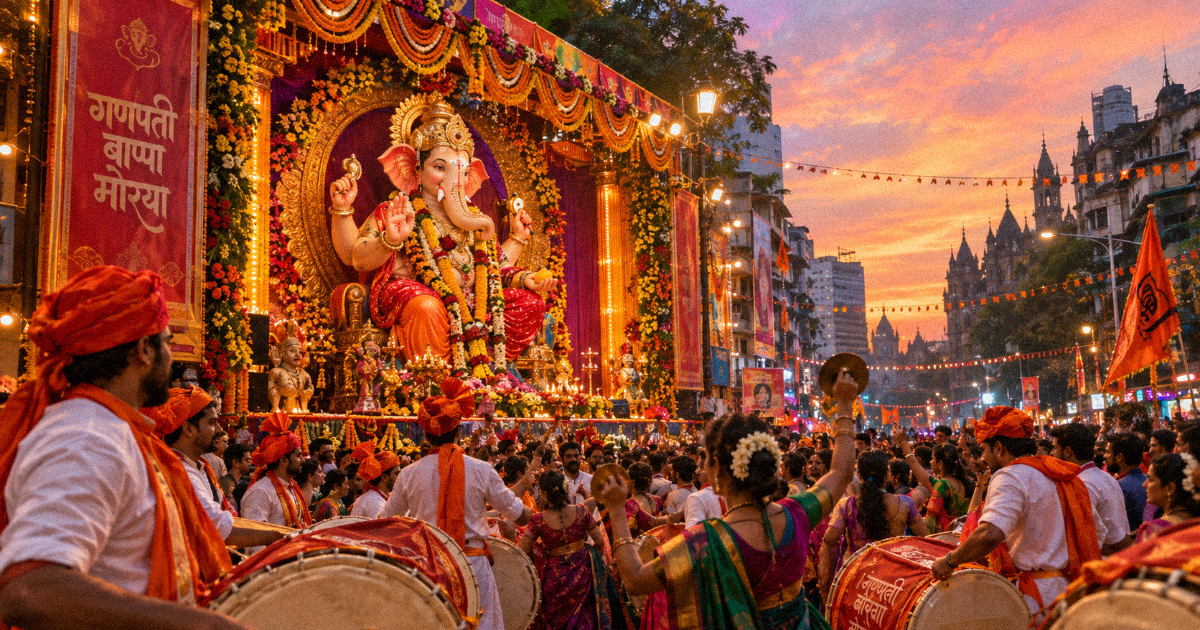
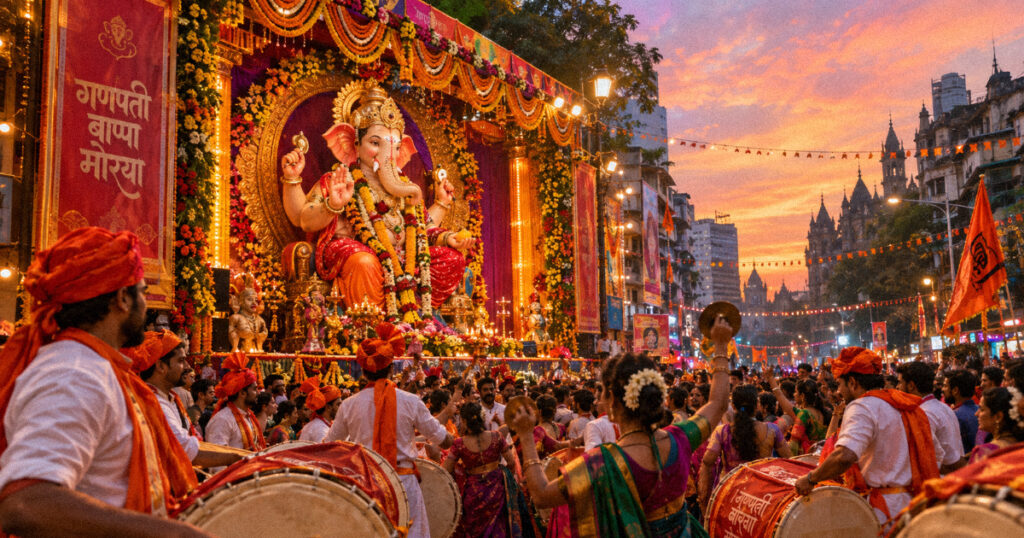
Public celebration of Ganesh Chaturthi as we know it today, with large idols, pandals, and street processions, was revived by Lokmanya Bal Gangadhar Tilak in 1893. Before this, the festival was mostly a private, home based worship.
Tilak turned it into a community festival to bring people together and build unity during India’s freedom struggle. This is why the ten day public festival, with its music, decorations, and community pandals, has a strong regional character in Maharashtra, Goa, Karnataka, and Andhra Pradesh, even though the private home worship exists across the whole country.
How long does the Ganesh idol stay: the common durations
Not every household keeps the idol for the same number of days, and there is no single correct answer. What matters is that whatever duration you choose, you should complete it with the same devotion at the start and the end.
- 1.5 days: The idol arrives on Chaturthi and is immersed the next afternoon. This is common among families who want the blessing without a long commitment, or where space at home is limited.
- 3 days: A short but complete cycle, often chosen by working families who cannot manage the longer version.
- 5 days: A popular middle ground, ending on Rishi Panchami or the fifth day after installation.
- 7 days: Common in many Maharashtrian households, ending before the final day.
- 10 days (Anant Chaturdashi): The most well known duration, especially for public pandals. This is the full cycle from Bhadrapada Shukla Chaturthi to Anant Chaturdashi, and in 2026 this means the idol stays from 14th September to 25th September.
- 11 or 21 days: Observed in some regions and by certain temples and families following specific family traditions, though this is less common at the household level.
Whichever duration you pick, the idol should never be kept beyond what was decided at the start of the puja, because the ritual itself is built around a beginning and a completion, similar to any vrat.
Astrological significance of Ganesh Chaturthi
Ganesha and the planet Ketu
In Vedic astrology, Ganesha is closely associated with Ketu, the shadow planet linked to detachment, sudden events, obstacles, and spiritual insight. Just as Ketu can create sudden blocks in a person’s chart, Ganesha is invoked as Vighnaharta, the remover of obstacles, because he governs the same territory that Ketu disturbs.
This is why people going through a difficult Ketu period, or a Ketu Mahadasha or Antardasha, are often advised to worship Ganesha regularly, and this festival becomes an especially potent time to start that practice.
The Chaturthi tithi itself
Every fourth tithi of the lunar fortnight, whether in the waxing or waning half, is ruled by Ganesha. This is not unique to Bhadrapada month. But when Chaturthi falls in Bhadrapada during Shukla Paksha, it becomes the most powerful of all Chaturthis in the year, because Bhadrapada is also the month linked to Purva Bhadrapada and Uttara Bhadrapada nakshatras, both of which carry themes of transformation, endings, and spiritual renewal.
Why the moon must not be seen on this day
This is one of the most specific and commonly misunderstood rules of the festival. According to the Puranic account, Ganesha fell off his mount, the mouse, after eating too many modaks, and the moon laughed at him. Angered, Ganesha cursed the moon so that anyone who looks at it on Chaturthi would face false accusation, known as Mithya Dosha or Syamantaka Dosha.
The moon avoidance window in 2026 falls between roughly 9:01 AM and 8:09 PM on 14th September. If you accidentally see the moon during this time, tradition offers a remedy: recite the Syamantaka Mani story, which is the same tale connected to Krishna being falsely accused of theft and later cleared of it. This remedy is considered enough to cancel the dosha.
Ganesha as the first deity of any puja. Astrologically, before any yagna, wedding, house warming, or new venture, Ganesha is invoked first. This is because he sits at the threshold between the material and the spiritual, much like the number four sits between the stability of three and the completeness of five in numerology. Starting anything, including a business, a marriage, or even a difficult conversation, is considered more favourable when done under his blessing.
Favourable for new beginnings. Because Ganesha rules new starts and clearing of obstacles, this ten day period is considered one of the best windows in the year to begin a new habit, start a course of study, sign a new agreement, or make a decision you have been delaying. Many astrologers recommend beginning important tasks specifically on Ganesh Chaturthi 2026 day itself, using the Madhyahna (midday) muhurat, since Ganesha’s own installation across India is traditionally done in this window rather than at sunrise.
Dos and don’ts of Ganesh Chaturthi
Dos
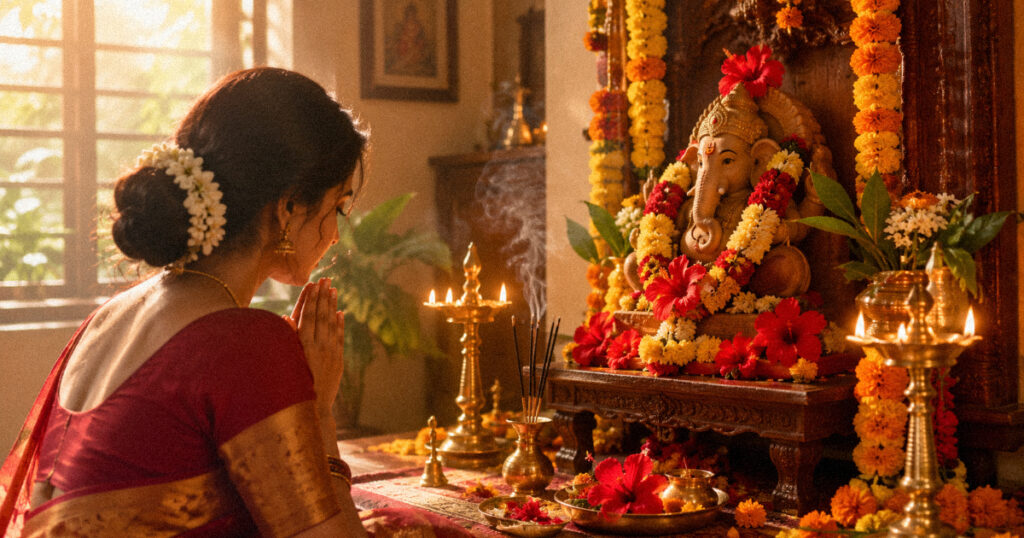
- Clean your home a day before. Sweep, mop, and decorate the puja space with flowers, torans, and rangoli at the entrance before the idol arrives.
- Bring the idol home in the morning, ideally before the Madhyahna muhurat, and welcome it at the door with an aarti before taking it inside.
- Perform Pranapratishtha, the ritual of inviting life force into the idol, right at the start of the puja. This is what transforms a clay figure into a living presence for the duration of your worship.
- Offer modaks and durva grass. Modak is Ganesha’s favourite sweet, and durva grass, a type of sacred grass, is considered one of his most cherished offerings, said to cool his temper and please him quickly.
- Chant his names and mantras daily, ideally during both morning and evening aarti, for the full duration the idol stays home.
- Choose an eco-friendly, clay idol wherever possible, since this affects how respectfully the immersion can be carried out without harming water bodies.
- Keep a sattvic diet during the days the idol is home, if your family tradition follows this practice. Even a partial fast until the midday puja is common and acceptable.
- Immerse the idol with the same devotion as you welcomed it, saying “Ganpati Bappa Morya, Pudhchya Varshi Lavkar Ya,” which means “Beloved Ganpati, come again quickly next year.”
Don’ts
- Do not look at the moon during the specified window on Ganesh Chaturthi day. If it happens accidentally, recite the Syamantaka Mani shloka as a remedy rather than worrying about the dosha.
- Do not keep the idol facing the wrong direction. The idol should generally face east or north, and not face the main door directly in a way that blocks entry.
- Do not touch the idol carelessly or without washing your hands, especially during the daily puja rituals.
- Do not use idols made from Plaster of Paris if you have a choice, since these do not dissolve properly during immersion and cause lasting harm to rivers and lakes.
- Do not extend the idol’s stay beyond the duration you decided at the start. If you committed to a 5 day or 10 day cycle, complete it on time.
- Do not consume non-vegetarian food or alcohol in the puja space or, in many traditions, anywhere in the home during the days the idol is present.
- Do not immerse the idol in a rush without the closing aarti. The visarjan ritual deserves the same attention as the installation.
Mantras to chant during Ganesh Chaturthi
You do not need to be a scholar of Sanskrit to chant these. Repetition and sincerity matter far more than pronunciation. Chant them during the morning and evening aarti, or any time you sit before the idol.
1. The Ganesh Gayatri Mantra Om Ekadantaya Vidmahe Vakratundaya Dhimahi Tanno Danti Prachodayat
This mantra is chanted for wisdom, clarity of thought, and removal of confusion. It is especially good to chant before starting any new project or study session.
2. Vakratunda Mahakaya Mantra Vakratunda Mahakaya Suryakoti Samaprabha Nirvighnam Kuru Me Deva Sarva Karyeshu Sarvada
This is the most widely known Ganesha mantra in Indian households. It is a direct request asking Ganesha to remove obstacles from all your undertakings, always.
3. The simple invocation Om Gan Ganapataye Namah
Short, easy to remember, and used for a general Ganesha invocation. This can be repeated in a mala of 108 for focused meditation.
4. Sankashtanashana Ganesh Stotra (opening line) Om Shri Ganeshaya Namah, Ekadantaya Vidmahe
Traditionally chanted when facing a specific difficulty or crisis, drawing on Ganesha’s role as the destroyer of troubles.
5. Ganesh Chaturthi closing chant Ganpati Bappa Morya, Mangal Murti Morya
This is not strictly a Sanskrit mantra but a devotional chant used throughout the festival and especially during visarjan, calling out to Ganesha with love and asking for his swift return next year.
Whether you keep the idol for a day and a half or the full ten days, what matters most is the intention behind the ritual, the care in the dos and don’ts, and the sincerity in the mantras you chant. Ganesha does not ask for perfection in ritual. He asks for devotion, and he is known to answer that devotion by clearing the path ahead.