
Saturn in Vedic Astrology – The story you should know
The Birth of Saturn in Vedic Astrology: Son of the Shadow
Our story begins with Chhaya.
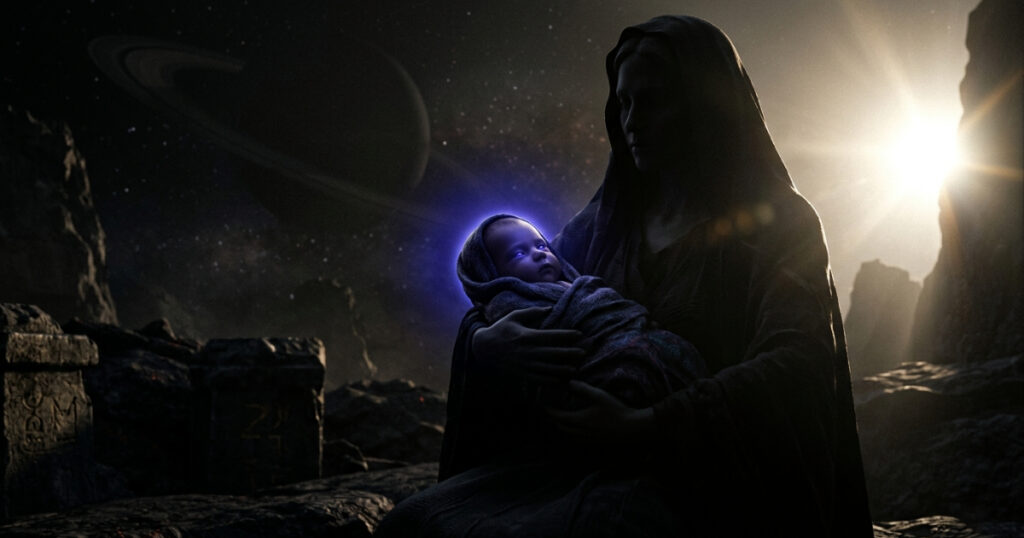
She was a shadow. A copy that Sanjna had made of herself before disappearing into the forests of Uttarakuru, placed beside Surya to hold the shape of a life that the real wife could no longer bear to live inside. Chhaya was convincing enough to fool the Sun god himself for years. But she could not fool herself. Every morning she woke up in a life that belonged to someone else, beside a being whose full radiance she had been built to withstand but never truly to love, and she carried that knowledge alone.
When Shani was born from her, he came into a particular kind of atmosphere.
His mother loved him. That is not in question. But Chhaya’s love for her own children had a quality that Sanjna’s children could feel was different, warmer, more anxious, more present, as though Chhaya was pouring into her own children everything she could not fully give to the life around her. Shani grew up at the centre of that love and at the edge of something unspoken. A household where the most important truth about his own mother was something nobody said out loud.
He was also born dark.
In a household that radiated the light of the Sun, Shani arrived with a complexion that absorbed rather than reflected. Dark-skinned, slow-moving, with eyes that carried a quality of depth and stillness that made people uncomfortable in the way that genuine stillness always makes people uncomfortable. He did not move at his father’s speed. He did not shine with his father’s brightness. He was, in almost every visible way, the opposite of what Surya Dev represented.
Surya noticed.
Why Surya Struggled to Accept His Own Son
The discomfort between father and son is recorded in the Puranas with a directness that is worth sitting with. Surya looked at this child and struggled to see himself in him. The darkness, the slowness, the quality of stillness that felt like its own kind of opposition to everything Surya was, created a distance that neither of them fully chose but both of them felt.
There is a version of the story where the first time Shani looked directly at his father, Surya’s body was affected. Some texts say Surya’s brightness dimmed momentarily. Others say his chariot horses stumbled. What the Puranas are describing in that image is the particular discomfort of a parent confronted with a child who reflects back something they have not yet looked at in themselves. Shani’s gaze did not carry malice. It carried truth. And truth, directed at the Sun, is its own kind of force.
Shani grew up carrying everything his origin implied.
He was the son of the shadow, which meant he was the son of the unexamined life. The consequence of a god who had been living without full awareness of what his own light was doing to the people closest to him. Shani did not choose this. He arrived into it. And the particular quality of his nature, slow, deliberate, deeply patient, oriented entirely toward what is real rather than what is bright, was shaped by exactly that origin.
He did not become bitter. He became precise.
The Crow, the Sword, and the Scale
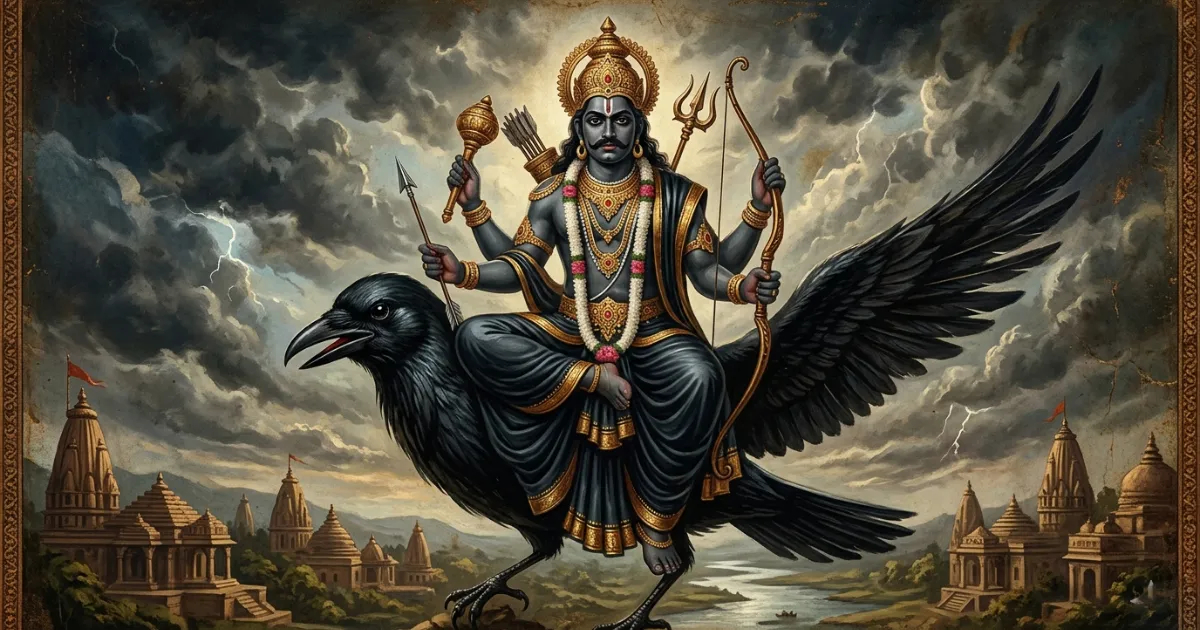
There is a story of a crow that is associated with Shani, his vehicle, the one he moves through the world on. The crow does not rush. It observes. It waits. It knows the difference between what is happening and what appears to be happening, and it does not confuse the two. Shani on his crow is a specific image. The slowest of the planets, moving through the zodiac at a pace that makes every other graha seem hurried, riding a bird that has always been associated with the ancestral realm, with what has been accumulated, with the weight of what came before.
He carries a sword and a scale. The sword for what must be cut away. The scale for the precise measurement of what is owed and what has been earned.
The relationship with Surya never fully resolved in the way that stories about fathers and sons sometimes resolve. There was no clean reconciliation scene. What there was instead was a gradual, mutual understanding of what each represented in relation to the other. Surya is the soul’s light and its expression in the world. Shani is what that light produces when it moves through time and consequence. You cannot have one without the other. The brightness of the Sun and the weight of Saturn are not enemies. They are the same story told across a longer arc.
Saturn in Vedic Astrology: Karma, Time, and Consequence
In Vedic astrology, Shani is the planet of karma, discipline, time, and consequence. He rules Capricorn and Aquarius. In Capricorn his energy is structural, oriented toward building, toward the slow accumulation of something real through sustained effort over time. In Aquarius he moves outward, toward the collective, toward the systems and structures that hold communities together or fail them.
He rules the tenth house of career, public life, and the legacy a person builds through their actions in the world. And the eleventh house of gains, of what is received after the work has been done. Both of these are about time. About what happens when effort meets duration.
He is the significator of the common people, of servants and labourers, of the elderly, of iron and oil and the things that move slowly and last. He governs the joints in the body, the structural framework that everything else is built on. He is the slowest moving of the visible planets, spending approximately two and a half years in each sign, and his transit through a sign, and especially his transit over the natal Moon in what is called Sade Sati, is one of the most discussed and most feared periods in Vedic astrology.
The fear is worth examining.
Shani does not punish. He measures. The confusion between the two is one of the most persistent misunderstandings in popular astrology. When Shani’s transit brings difficulty, what is actually happening is that the weight of accumulated actions, choices made without full awareness, debts that have been running in the background of a life, is coming to the surface to be settled. Shani brings the bill. He does not write it. The bill was being written all along.
And when Shani brings reward, which he does, it is the same principle in the other direction. The patient effort, the discipline maintained when it would have been easier to stop, the integrity held when no one was watching, all of it accumulates in Shani’s ledger and is returned at the right time with the precision of someone who has been keeping exact accounts.
He gives nothing for free. He takes nothing that was not already owed.
Born from a shadow, raised in a household built on an unspoken truth, carrying a gaze that made even the Sun uncomfortable. Shani became the planet who ensures that nothing in a life goes unaccounted for. Not because he is harsh. Because he understood from the very beginning that the things left unexamined do not disappear. They accumulate. And eventually they come back, in one form or another, asking to be seen.
Where Shani Sits in Your Chart
Where Shani sits in your chart is where that principle is most active in your life. The house shows you the arena where patience, discipline, and the settling of accounts is the dominant curriculum. The sign shows you the texture of how that energy moves. The aspects he makes show you which other areas of life are being drawn into that same conversation.
Your Saturn placement is not a warning. It is a description of where the most honest and most demanding work of this lifetime is concentrated.
And Shani, of all the planets, is the one who will make absolutely sure that work gets done.
Reach out for a consultation if you want to understand what Shani is pointing to in your chart.
Frequently Asked Questions
Who is Saturn in vedic astrology?
Shani Dev is the Hindu god of karma, justice, and time, and the ruling deity of the planet Saturn in Vedic astrology. He is the son of Surya, the Sun god, and Chhaya, the shadow. Born dark in a household of light, slow in a cosmos that moved at his father’s speed, he became the planet responsible for ensuring that every action in a life is eventually accounted for, not as punishment, but as precision.
Why is Shani Dev feared?
The fear is largely a misunderstanding. Shani does not create difficulty. He surfaces it. When his transit brings hardship, what is actually arriving is the weight of choices made without full awareness, including debts that have been accumulating in the background of a life, now coming forward to be settled. People fear the accountant when what they are really responding to is the size of the bill.
What is Sade Sati of Saturn in vedic astrology?
Sade Sati is the seven-and-a-half-year period during which Saturn transits over your natal Moon – two and a half years in the sign before it, two and a half across it, and two and a half in the sign that follows. It is one of the most discussed transits in Vedic astrology, and one of the most misunderstood. It does not guarantee suffering. It guarantees that whatever has been left unexamined in a life will be brought to the surface. For some people, that is the most productive period they have ever lived through.
Why is Shani Dev dark-skinned?
According to the Puranas, Shani’s dark complexion came from Chhaya’s penance during her pregnancy. She was a devoted follower of Shiva and practised such intense austerity, without food, without shade, standing in the full heat of the sun, that its effect passed into the child she was carrying. He arrived already shaped by endurance. The darkness was not a flaw ofcourse. It was the first evidence of what he was made of.
What does Shani Dev’s vehicle, the crow, represent?
The crow does not rush. It observes from a distance, waits, and knows the difference between what is happening and what merely appears to be happening. As Shani’s vehicle, it is exactly the right image — the slowest of the planets, moving through the zodiac at a pace no other graha matches, carried by a bird that has always been associated with the ancestral realm, with accumulated knowledge, with the weight of what came before.