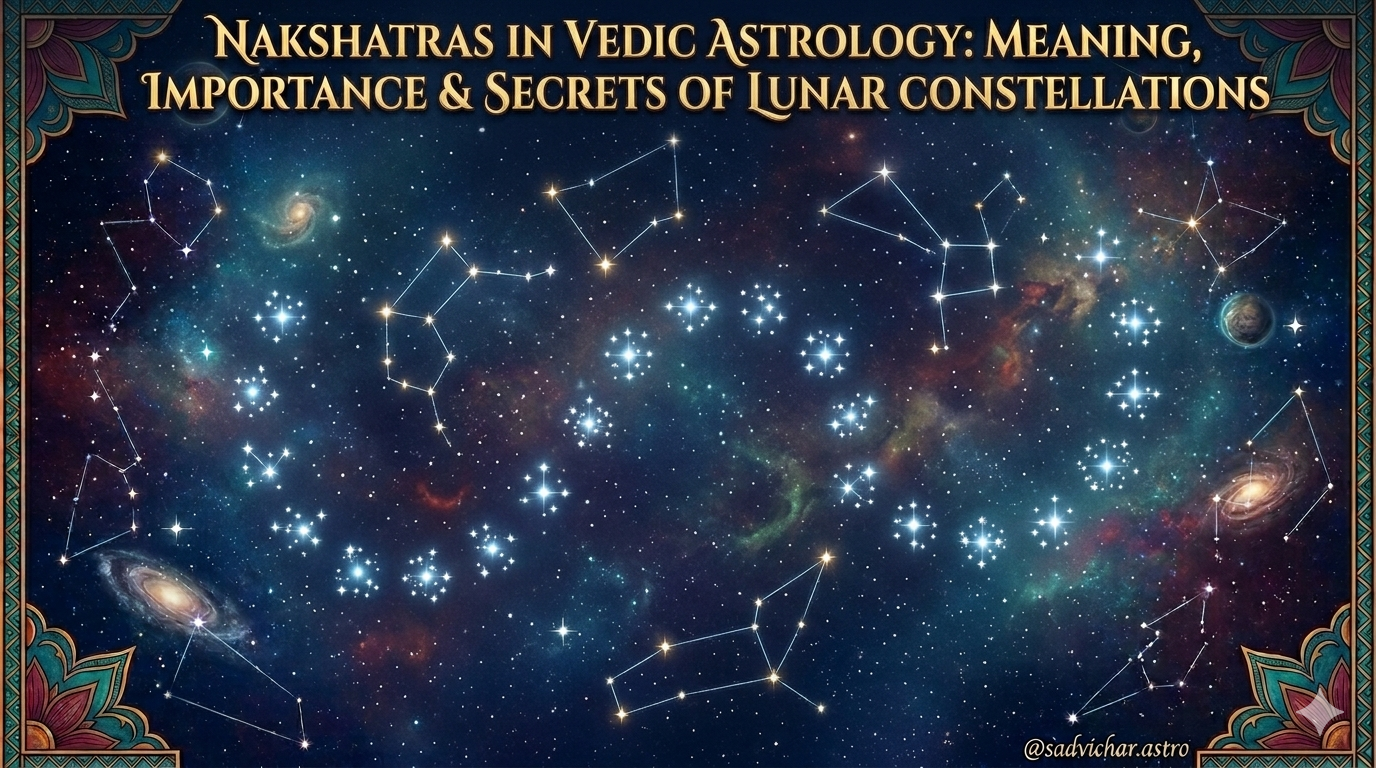
Nakshatras in Vedic Astrology: Meaning, Importance & Secrets of Lunar Constellations
Have you ever wondered why two people born under the same Aries Sun act as differently as fire and water? While mainstream horoscopes focus on broad strokes, the true secret of human destiny lies within the Nakshatras in Vedic astrology. Most enthusiasts believe zodiac signs are the final word, but they are merely the skin. The Nakshatras are the nervous system—the subtle, vibrating blueprint of your soul’s journey through time.
What are Nakshatras in Vedic astrology?
In the ancient language of Sanskrit, the term Nakshatra carries two profound meanings that explain their cosmic function. The first derivation, Naks (sky) and Kshetra (region), defines them as specific sectors of the heavens. The second, Naksha (map) and Tara (star), identifies them as a celestial map used by seers to track the soul’s evolution.
Technically, Nakshatras in Vedic astrology are 27 equal divisions of the ecliptic, each spanning exactly 13°20’. While the Sun takes thirty days to cross a zodiac sign, the Moon—our closest celestial neighbour—crosses one Nakshatra roughly every 24 hours. Consequently, these lunar mansions serve as a “cosmic clock,” allowing for a level of predictive precision that zodiac signs simply cannot match.
Why Nakshatras are more important than zodiac signs
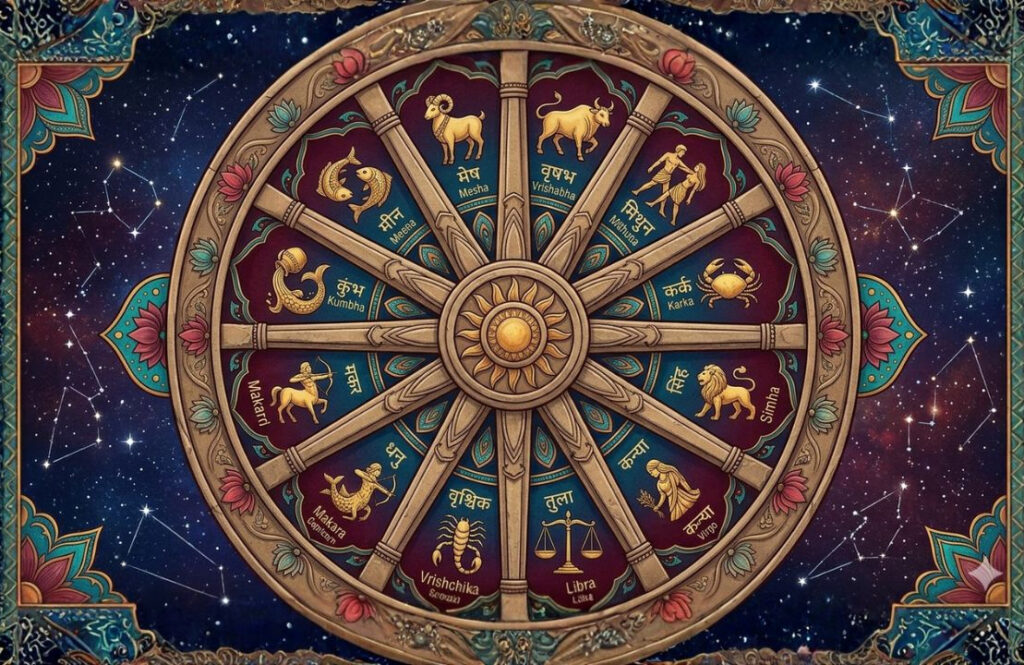
If you view the 12 zodiac signs as 12 large rooms in a mansion, the 27 Nakshatras are the specific furniture, lighting, and atmosphere within those rooms. The zodiac provides a broad psychological framework, but vedic astrology predictions rely on Nakshatras to reveal the underlying motivation.
Because the Moon governs the mind (Manas) and our emotional perception, its position in a specific moon nakshatra dictates how we absorb energy. It is the filter through which we experience reality. One person may see a crisis as a disaster, while another sees it as an opportunity—this fundamental difference in perception is rooted entirely in their birth nakshatra.
The role of the Moon: the emotional engine
In Jyotisha, the Moon acts as a cosmic sponge. It does not possess its own light but reflects and modifies the light of the stars. Therefore, the Nakshatra in which the Moon resides at birth becomes the most critical point of the horoscope.
Your birth nakshatra defines:
Your Thinking Pattern:
Are you analytical, creative, or impulsive?
Emotional Reactions:
Do you retreat when stressed or confront the issue?
Psychological Fuel:
What truly makes you feel safe and nourished?
The 27 Nakshatras system
The system primarily utilizes 27 divisions, though a 28th “intercalary” Nakshatra called Abhijit exists for specific ritualistic and timing purposes. Each of the 27 nakshatras is ruled by a specific deity and a planetary lord, giving it a unique “shakti” or power.
Ashwini (The Healer)
Bharani (The Bearer)
Krittika (The Cutter)
Rohini (The Creative)
Mrigashira (The Searcher)
Ardra (The Moist/Stormy)
Punarvasu (The Restorer)
Pushya (The Nourisher)
Ashlesha (The Embracer)
Magha (The Magnificent)
Purva Phalguni (The Artistic)
Uttara Phalguni (The Noble)
Hasta (The Hand)
Chitra (The Architect)
Swati (The Independent)
Vishakha (The Goal-Oriented)
Anuradha (The Devoted)
Jyeshtha (The Elder)
Moola (The Root)
Purva Ashadha (The Invincible)
Uttara Ashadha (The Universal)
Shravana (The Listener)
Dhanishta (The Wealthy)
Shatabhisha (The Hundred Physicians)
Purva Bhadrapada (The Spiritual Fire)
Uttara Bhadrapada (The Warrior Priest)
Revati (The Wealthy/Transcendental)
Nakshatra structure: Padas and the 108 divisions
Vedic wisdom operates on the principle of nested cycles. Every Nakshatra is further divided into four Padas (quarters) of 3°20’ each. This results in 108 Padas across the entire zodiac.
The number 108 holds immense spiritual significance in Sanatan Dharma, appearing in prayer beads (Malas) and sacred architecture. Each Pada is associated with a specific sound. Traditionally, a child’s name begins with the sound of the Pada occupied by their Moon at birth, ensuring their social identity vibrates in harmony with their cosmic blueprint.
Nakshatras as energy filters for planets
Planets are like actors, and Nakshatras are the stage environments. A planet’s behavior shifts radically depending on the “costume” it wears. For example, Mars in Pushya (ruled by Saturn and Brihaspati) becomes disciplined and protective, whereas Mars in Ashlesha (ruled by Mercury) becomes cunning and sharp-tongued.
When we look at Nakshatras in Vedic astrology, we see that they act as environmental filters. They can turn a naturally “malefic” planet into a “benefic” force if the environment supports the planet’s higher purpose.
The Dasha system: timing your destiny
The most powerful application of the birth nakshatra is the Vimshottari Dasha system. This unique predictive tool calculates the periods of your life based on the exact degree of the Moon at birth.
Your journey through life is not random. The Dasha system reveals a predetermined sequence of planetary influences. If you are born in a Ketu-ruled star, your life begins with a seven-year cycle of Ketu, followed by twenty years of Venus. Understanding this sequence allows us to predict the timing of career shifts, marriage, and spiritual awakenings with breathtaking accuracy.
The psychology of perception
Why do some people instinctively see the silver lining while others see only the cloud? Modern psychology attributes this to personality, but Vedic seers attribute it to the “elemental balance” of the moon nakshatra.
If you are born in a “Fire” Nakshatra (like Krittika), your mind processes information with heat and intensity. You seek clarity and truth. Conversely, a “Water” Nakshatra (like Punarvasu) processes reality through the lens of memory, emotion, and restoration. By studying Nakshatras in Vedic astrology, we can deconstruct our mental biases and achieve a state of objective awareness.
Gandanta: the karmic knots
There are three points in the zodiac where the transition is particularly turbulent. These are called Gandanta points—the “junctions” between a Water sign and a Fire sign.
Ashwini (Fire) – Revati (Water)
Magha (Fire) – Ashlesha (Water)
Moola (Fire) – Jyeshtha (Water)
Being born with the Moon or Ascendant in a Gandanta Nakshatra often signifies a soul dealing with “karmic knots.” These individuals usually experience intense emotional transformations or “ego deaths” that lead to profound spiritual maturity.
The myth of the Moon and his 27 wives
Mythology provides the emotional context for these celestial mechanics. The 27 lunar mansions are personified as the daughters of King Daksha. They were all married to Chandra (the Moon God).
Chandra, however, fell deeply in love with Rohini and spent all his time in her mansion, ignoring his other 26 wives. The neglected sisters complained to their father, who cursed Chandra to waste away. This curse created the waning Moon. Only after Chandra begged for mercy did Shiva intervene, allowing him to wax again for 14 days. This story explains why the Moon must visit every Nakshatra equally, teaching us the importance of balance in our own mental and emotional lives.
Practical applications in daily life
The study of Nakshatras in Vedic astrology is not purely academic; it is a functional tool for living:
Career:
Certain stars favor technical writing and logic, while others favor artistic design or healing.
Relationship Matching:
Koota matching uses Nakshatras to determine if two people can coexist emotionally.
Muhurta:
We use the daily Nakshatra to choose the best time for starting a business, buying a home, or traveling.
Key takeaways
Precision:
Nakshatras offer 27 divisions compared to the 12 zodiac signs.
Emotional Core:
The Moon’s Nakshatra is the “entry point” of the soul into the physical realm.
Padas:
The 108 quarters provide the phonetic vibration for our names.
Timing:
The Dasha system, rooted in Nakshatras, provides the timeline of life events.
Mythology:
The story of Rohini and Chandra highlights the human struggle with attachment and balance.
Conclusion: a journey through the stars
Understanding Nakshatras in Vedic astrology is akin to receiving the user manual for your own mind. It moves us away from the “what” of our lives and into the “why.” By recognizing the stellar environment we were born into, we can stop fighting our nature and start flowing with it. Whether you are navigating a difficult Saturn period or trying to understand your emotional triggers, the lunar mansions provide a light in the dark.
28 Comments